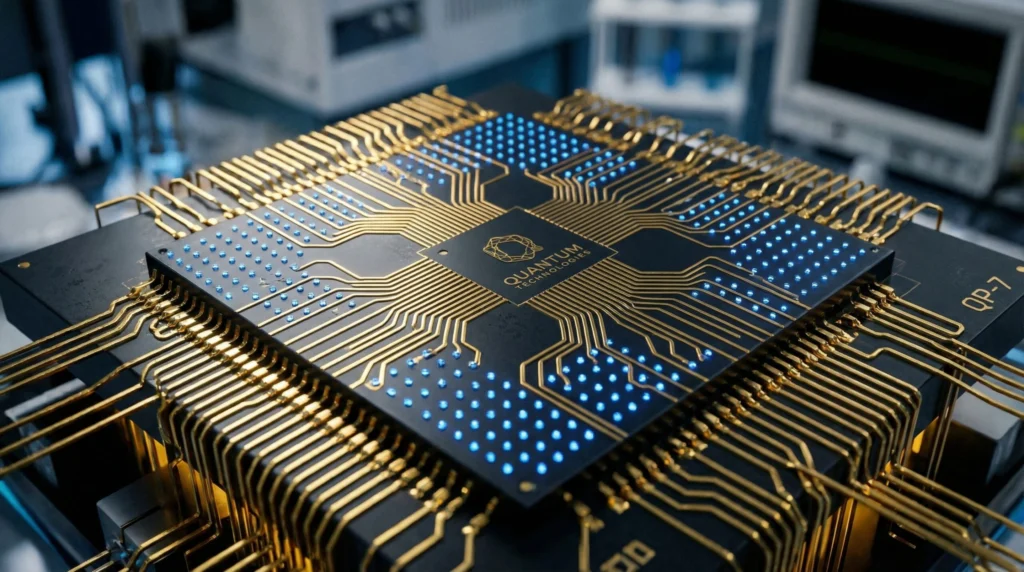
Quantum computing stands at the cusp of transforming how we solve the world’s most complex problems. From drug discovery to climate modeling, these machines harness the bizarre rules of quantum mechanics superposition and entanglement to perform calculations that would take classical supercomputers billions of years. The latest breakthroughs in quantum computing 2024 marked a pivotal shift from experimental hype to tangible progress, with error correction finally scaling reliably and the first hints of verifiable quantum advantage emerging.
As we move into quantum computing breakthroughs 2026, hybrid systems and quantum AI integrations are accelerating real-world applications. This article explores these latest advancements in quantum computing, spotlighting the Google quantum computer, the groundbreaking quantum echoes algorithm, the path to a quantum breakthrough 2025, and even how quantum computing stocks are positioning investors for the future. We’ll also address popular questions, like the power of a million qubits and what Elon Musk thinks about the technology.
These developments aren’t just academic they promise to reshape industries and challenge our understanding of computation itself.
The 4 Pillars of Quantum Technology
Quantum technology rests on four foundational pillars that work together to unlock its full potential. Understanding them provides context for why breakthroughs in quantum computing matter beyond raw processing power.
- Quantum Computing and Simulation This pillar uses qubits to solve optimization, chemistry, and machine-learning problems exponentially faster than classical systems. It powers everything from molecular modeling to financial forecasting.
- Quantum Communication Leveraging entanglement for unbreakable encryption via quantum key distribution (QKD), this pillar creates secure networks resistant to future quantum attacks.
- Quantum Sensing and Metrology Ultra-sensitive sensors detect minute changes in gravity, magnetic fields, or time with unprecedented precision applications range from medical imaging to underground resource exploration.
- Quantum Simulation (often grouped with computing but distinct) Dedicated simulators replicate quantum systems (like high-temperature superconductors) that classical computers cannot handle accurately.
These pillars interconnect. Advances in one, such as better error-corrected qubits, boost the others. McKinsey estimates the combined market could reach tens of billions by 2035, driven by quantum AI synergies.
Breakthroughs in Quantum Computing in 2024: Error Correction Takes Center Stage
2024 was the year breakthroughs in quantum computing moved from noisy intermediate-scale quantum (NISQ) devices toward fault-tolerant systems. The biggest headline came from Google Quantum AI with its Willow chip a 105-qubit superconducting processor that achieved exponential error suppression as qubit count increased.
Previously, adding more qubits amplified errors exponentially. Willow flipped the script: the more physical qubits used for error correction, the lower the logical error rate dropped. Researchers demonstrated that scaling from a handful to dozens of logical qubits reduced errors by orders of magnitude, cracking a 30-year barrier in the field.
Other 2024 milestones included:
- Harvard and QuEra teams integrating 48 logical qubits with full connectivity for complex operations.
- Microsoft and Atom Computing unveiling reliable logical qubits with error rates 800 times better than physical ones.
- Improved coherence times in neutral-atom and photonic systems, pushing toward practical utility.
These latest advancements in quantum computing proved that fault tolerance isn’t decades away it’s an engineering challenge we’re solving now.
Quantum Breakthrough 2025: The Quantum Echoes Algorithm and Verifiable Quantum Advantage
Building directly on Willow, Google delivered a quantum breakthrough 2025 that many experts call the first true demonstration of practical quantum superiority. The quantum echoes algorithm ran on the Willow chip and achieved verifiable quantum advantage outperforming the best classical supercomputer by roughly 13,000 times while solving a problem that can be independently checked.
How the quantum echoes algorithm works (in simple terms):
- Perform a series of quantum operations forward on the qubit array.
- Perturb a single qubit to create a “disturbance.”
- Run the operations backward.
- Measure the overlap to reveal how the disturbance propagated like an echo revealing hidden structure.
This technique excels at modeling magnetic spins in molecules or materials, directly enhancing NMR spectroscopy for drug discovery and materials science. Unlike many prior claims, results are verifiable across different quantum processors or even natural systems. It marks the shift from “quantum supremacy” demos (random circuit sampling) to algorithms with clear scientific value.
Other 2025 highlights included Quantinuum’s Helios system claiming record accuracy for generative quantum AI, and rapid progress in magic-state distillation essential for universal fault-tolerant computing. By late 2025, hybrid quantum-classical workflows began delivering commercial pilots in optimization and chemistry.
Latest Advancements in Quantum Computing: Trends Shaping 2026 and Beyond
Quantum computing breakthroughs 2026 emphasize practicality. Industry leaders predict the year of “useful quantum computing,” where hybrid systems solve niche but valuable business problems. Key trends include:
- Quantum AI integration: AI optimizes qubit control and error mitigation, while quantum processors accelerate AI training on intractable datasets.
- Modular architectures: Companies like IBM and IonQ scale via networked chips rather than monolithic monsters.
- Early commercial advantage in finance, logistics, and pharmaceuticals.
Neutral-atom platforms (QuEra, Atom Computing) and trapped-ion systems lead in logical qubit counts, while superconducting chips (Google, IBM) push raw speed. Photonic approaches promise room-temperature operation for easier scaling.
Google Quantum Computer: Willow Leading the Pack
The Google quantum computer specifically Willow remains the benchmark. Its 105 physical qubits delivered state-of-the-art gate fidelities (99.97% single-qubit, 99.88% two-qubit) and coherence times approaching 100 microseconds. Most impressively, it completed billions of error-correction cycles without catastrophic failure. Google’s roadmap now targets cryptographically relevant machines by the early 2030s, with quantum echoes proving the hardware’s real-world readiness.
Quantum Computers Predicting the Future: From Science Fiction to Reality
Hollywood has long imagined quantum computer predict future movie scenarios. In the acclaimed series Devs, a quantum computer uses perfect determinism to forecast human behavior seconds or even years ahead, raising profound questions about free will. Similar themes appear in Westworld and films featuring predictive quantum AI.
In reality, quantum AI is beginning to deliver probabilistic forecasts far superior to classical methods. By simulating vast possibility spaces, quantum systems excel at Monte Carlo-style predictions in finance (portfolio risk), climate modeling, and drug interaction forecasting. While we won’t achieve 100% accurate future prediction anytime soon (quantum mechanics is inherently probabilistic), these tools already provide unprecedented foresight for decision-making.
The Power of 1,000,000 Qubits: A Game-Changer on the Horizon
Current devices hover around 100–1,000 physical qubits. A 1,000,000-qubit (one million) machine would represent an entirely different league. Microsoft’s Majorana-based architecture aims for exactly this scale on a single palm-sized chip, claiming it could solve problems beyond the combined power of every classical computer on Earth today.
With one million qubits (yielding thousands of logical qubits after error correction), we could:
- Simulate complex molecules for new catalysts or personalized medicines in hours instead of centuries.
- Optimize global supply chains or traffic networks in real time.
- Break most current public-key encryption, necessitating post-quantum cryptography migration.
Experts note that even 100 logical qubits could outperform classical systems on specific tasks; one million would unlock industrial-scale quantum advantage across multiple domains.
Quantum Computing Stocks: Where Investors Are Placing Bets
The commercial race is fueling quantum computing stocks. Pure-play leaders include IonQ (trapped-ion leader with cloud access via major providers), Rigetti (superconducting focus), and D-Wave (annealing systems for optimization). Big Tech players like Alphabet (Google), IBM, Microsoft, and Amazon offer indirect exposure through their quantum divisions and cloud services.
| Company | Primary Technology | Notable 2024-2026 Milestone | Investment Thesis |
|---|---|---|---|
| IonQ | Trapped ions | High-fidelity logical qubits | Pure-play leader, cloud partnerships |
| Rigetti | Superconducting | Modular scaling and real-time error correction | Vertically integrated hardware |
| D-Wave | Quantum annealing | Commercial optimization pilots | Near-term revenue in logistics |
| Alphabet (Google) | Superconducting | Willow + Quantum Echoes algorithm | Verifiable advantage pioneer |
| IBM | Superconducting | Heron/Nighthawk processors, 200+ logical qubits roadmap | Enterprise ecosystem |
What Does Elon Musk Say About Quantum Computing?
Elon Musk has followed progress closely. After Google’s Willow and quantum echoes announcements, he simply posted “Wow” on X high praise from a technologist who rarely comments on competitors. Musk has also suggested that permanently shadowed lunar craters offer ideal natural refrigeration for quantum hardware due to their extreme cold and isolation. He acknowledges quantum computing’s rapid advancement toward commercial relevance while warning of cybersecurity implications (e.g., potential threats to Bitcoin encryption). Overall, Musk views the field positively as another frontier of technological progress.
FAQ: Common Questions About Breakthroughs in Quantum Computing
What are the breakthroughs in quantum computing in 2024?
Key highlights include Google’s Willow chip demonstrating scalable error correction and multiple teams achieving dozens of logical qubits with dramatically reduced error rates.
What are the 4 pillars of quantum technology?
They are Quantum Computing/Simulation, Quantum Communication, Quantum Sensing/Metrology, and dedicated Quantum Simulation forming the ecosystem that drives innovation.
How powerful is 1,000,000 qubits?
A million-qubit system could tackle problems intractable for all classical computers combined, enabling full molecular simulations, unbreakable optimization, and practical quantum advantage across industries.
What does Elon Musk say about quantum computing?
Musk has expressed amazement at recent advances (“Wow” to Google’s breakthroughs) and proposed lunar craters as ideal environments, while noting both promise and security risks.
What is the quantum echoes algorithm?
Google’s 2025 innovation that creates “echoes” of qubit disturbances to model spin interactions 13,000x faster than classical methods delivering the first verifiable quantum advantage for chemistry applications.
How does quantum AI differ from classical AI?
Quantum AI leverages qubits for parallel exploration of solution spaces, accelerating optimization and simulation tasks that classical neural networks struggle with.
When will quantum computers be commercially useful?
Early niche applications are emerging in 2025–2026; broad industrial impact is expected in the early 2030s as fault-tolerant systems mature.
Conclusion: The Quantum Future Is Accelerating
The latest breakthroughs in quantum computing 2024 capped by Willow’s error-correction milestone and followed by the quantum echoes algorithm in 2025 have propelled the field into a new era. With quantum computing breakthroughs 2026 focusing on hybrid quantum AI and practical use cases, we’re no longer asking “if” but “how soon” these machines will reshape our world.
Whether you’re a researcher, investor eyeing quantum computing stocks, or simply curious about technology that could one day predict molecular futures better than any classical system, now is the time to engage.
