
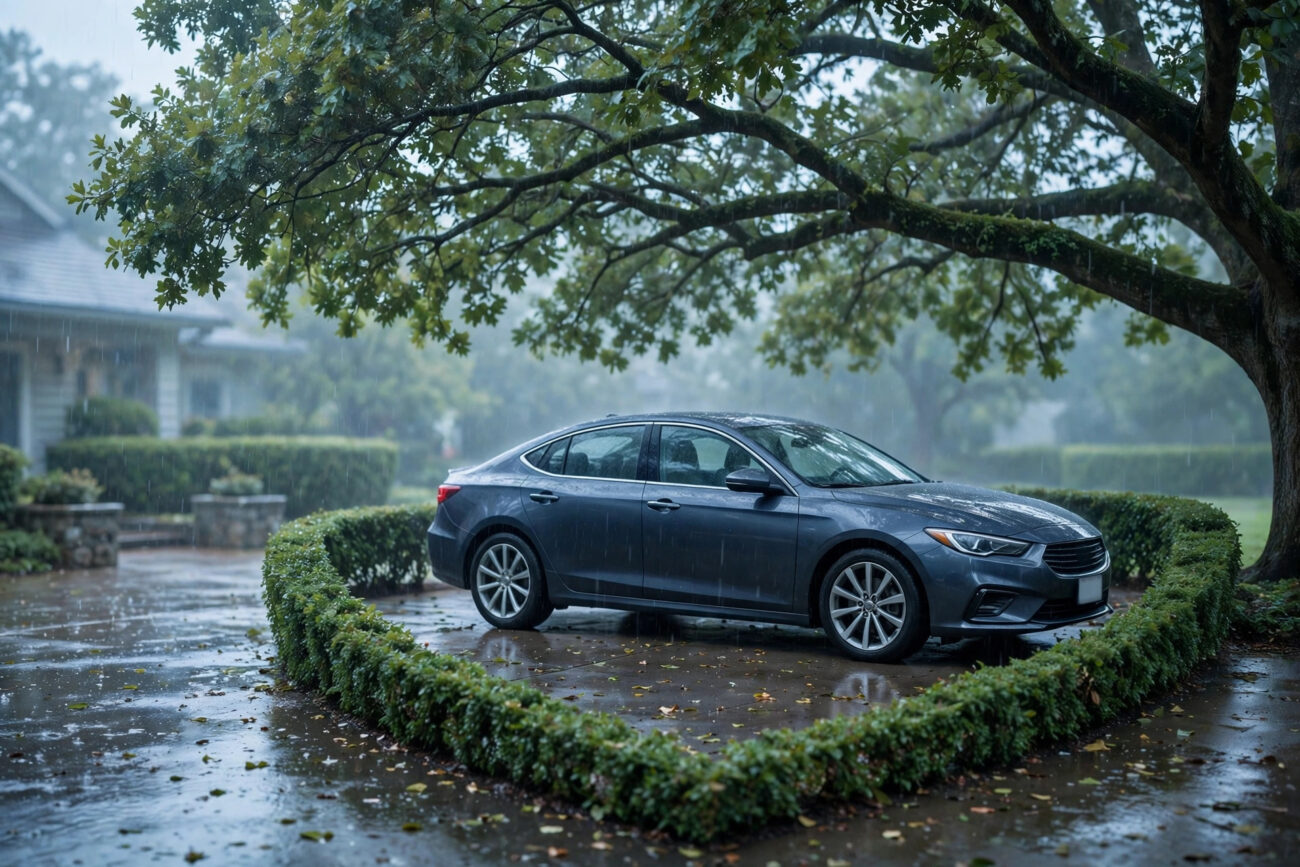
A tree falls on your parked car during a storm. Someone steals it from a parking lot overnight. Hail dents the roof and cracks the windshield. None of these involve a crash with another vehicle, and none of them are covered by liability insurance. That is the gap comprehensive coverage fills. What is comprehensive car insurance coverage? It is the part of your auto policy that pays to repair or replace your own car after damage from events other than a collision, theft, fire, weather, vandalism, falling objects, and hitting an animal. In this guide, you will learn exactly what comprehensive coverage pays for, what it excludes, how much it typically costs, how it differs from collision and liability coverage, and when it makes sense to keep it or drop it.
What Is Comprehensive Car Insurance Coverage?
Comprehensive coverage is an optional part of an auto insurance policy that covers damage to your own vehicle from causes other than a collision. It pays if your car is stolen, damaged by fire, flood, hail, or a falling tree, vandalized, or damaged when you hit a deer. The key idea is simple: collision covers crashes, and comprehensive covers almost everything else that can happen to a parked or driven car.
The name causes a common misunderstanding. “Comprehensive” sounds like it covers everything, but it does not, it covers a specific list of non-collision perils, and it never covers injuries, damage you cause to other people, or mechanical breakdowns. About 80% of insured drivers buy comprehensive coverage alongside liability insurance, according to the Insurance Information Institute, and most buy it together with collision coverage as part of a “full coverage” policy.
No state requires comprehensive coverage by law. But if you finance or lease your car, your lender almost certainly requires it, lenders want their collateral protected until the loan is paid off. Once you own the car outright, the choice is yours, and the rest of this guide will help you make it.
What Does Comprehensive Coverage Cover?
Comprehensive coverage pays for damage to your vehicle from a defined set of non-collision events. The exact list varies slightly by insurer, but these perils are covered under nearly every comprehensive policy in the United States:
- Theft: your car is stolen, or parts of it are stolen, such as the catalytic converter.
- Weather damage: hail, flooding, hurricanes, tornadoes, lightning, windstorms, and wildfires.
- Fire: including a fire in your garage or an engine fire not caused by a crash.
- Vandalism: keyed paint, slashed tires, broken windows, spray paint, and other intentional damage.
- Animal strikes: hitting a deer or other animal. This is the one exception to the “no collision” rule: an animal collision is a comprehensive claim, not a collision claim.
- Falling objects: a tree branch, rocks, or debris that falls on your car.
- Civil unrest: damage from riots or civil commotion.
- Glass damage: a cracked or shattered windshield, often with a lower deductible or, in some states, no deductible at all.
Coverage applies wherever your car is parked, in your driveway, in a parking lot, or in your garage. If a tree falls on your car at home, comprehensive pays; your homeowners policy covers the garage structure, not the vehicle. Likewise, if your car is stolen from a parking lot across town, comprehensive covers the theft regardless of location.
What Comprehensive Coverage Does Not Cover
Knowing the exclusions is just as important as knowing the coverage. Comprehensive insurance does not pay for:
| Not Covered | Why Not / What Covers It Instead |
|---|---|
| Collisions with other vehicles or objects | That is collision coverage, a separate part of your policy |
| Damage or injuries you cause to others | Liability coverage handles third-party claims |
| Injuries to you or your passengers | Personal injury protection (PIP), MedPay, or health insurance |
| Mechanical breakdowns and wear and tear | No auto insurance covers these; a warranty or repair fund does |
| Routine maintenance | Oil changes, tires, brakes, and servicing are owner costs |
| Personal belongings stolen from inside the car | A stolen laptop or bag falls under homeowners or renters insurance |
| Custom parts beyond policy limits | Aftermarket upgrades may need added custom-equipment coverage |
Two of these surprise people most. First, comprehensive covers the theft of your car itself, but not the things left inside it, a stolen laptop, purse, or golf clubs are a homeowners or renters insurance matter. Second, it never covers a mechanical failure: if your engine dies or your transmission fails, that is a repair bill, not an insurance claim. Read your policy’s exclusions section before assuming something is covered.
Comprehensive vs. Collision Coverage
Comprehensive and collision are the two coverages that protect your own car, and most drivers carry both. The difference is the cause of the damage:
- Comprehensive pays for non-collision damage: theft, weather, fire, vandalism, falling objects, and animal strikes.
- Collision pays for damage when your car hits, or is hit by, another vehicle or an object, such as a pole, fence, or guardrail, while it is being driven.
Together, the two coverages protect your vehicle from nearly every scenario, which is why about 79% of drivers who buy comprehensive also buy collision, according to MoneyGeek’s analysis of shoppers. You can buy either one alone, but dropping collision while keeping comprehensive leaves you exposed to the most common kind of damage, a crash, and dropping comprehensive while keeping collision leaves you exposed to theft and weather.
Both coverages work the same way at claim time: you pay your deductible first, and the insurer pays the rest up to your car’s actual cash value. Both are optional if you own your car outright, and both are usually required by lenders until a financed or leased car is paid off.
Comprehensive vs. Liability and Other Coverages
Comprehensive is often confused with other parts of a policy, so here is how it compares with the coverages drivers most often mix it up with.
Comprehensive vs. liability: Liability coverage pays for damage and injuries you cause to other people in an accident. It is required by law in almost every state (New Hampshire is the exception) and it never pays to repair your own car. Comprehensive does the opposite: it pays for your car and never pays for damage to others.
Comprehensive vs. uninsured motorist: Uninsured motorist coverage pays for your damage when another driver hits you and has no insurance (or too little). Comprehensive does not help there, if an uninsured driver crashes into you, that is a collision or uninsured motorist claim, not a comprehensive one.
Comprehensive vs. full coverage: “Full coverage” is not a single coverage at all, it is a bundle that typically means liability plus collision plus comprehensive. When someone says they have full coverage, they usually mean they carry all three.
How Much Does Comprehensive Coverage Cost?
Comprehensive coverage is one of the cheaper parts of an auto policy. According to MoneyGeek’s analysis of more than 2.4 million quotes, comprehensive coverage averages roughly $200 to $350 per year on its own, though other analyses put the average lower, around $134 per year, because averages vary with the mix of cars, locations, and deductibles in each study. Either way, it is a small slice of a typical full-coverage policy, which averages about $137 per month nationally.
Two factors move the price more than anything else. First, your car’s value: a $50,000 truck costs more to insure comprehensively than a $15,000 sedan, because there is more for the insurer to pay after a theft or total loss. Second, your ZIP code: drivers in hail-prone areas such as North Texas and Colorado, high-theft urban areas, and regions with large deer populations pay more than drivers in low-risk areas, in some analyses, $100 to $200 more per year for the same coverage.
Your deductible matters too. A $500 deductible is the most common choice; a $1,000 deductible lowers the cost of this coverage by roughly 15% on average, but raises what you pay after a claim. Comprehensive premiums have also been rising, up 21% in 2023, according to the National Association of Insurance Commissioners, so a price that was cheap two years ago may not be cheap today. Get fresh quotes at each renewal.
How the Deductible Works
Unlike liability coverage, comprehensive coverage has no limit you choose, the maximum payout is your vehicle’s actual cash value (ACV) at the time of the loss. Your only real choice is the deductible: the amount you pay out of pocket before the insurer pays the rest. Deductibles for comprehensive coverage usually run from $100 to $2,500, with $500 the most common choice.
Here is how it works in practice. If a hailstorm causes $3,000 of damage and your comprehensive deductible is $500, you pay $500 and your insurer pays $2,500. If the damage costs less than your deductible, say a $300 windshield chip with a $500 deductible, you pay the whole repair yourself, and filing a claim would gain nothing.
Claims are usually paid at actual cash value, which accounts for your car’s age, condition, and mileage. Some policies offer a replacement cost add-on that skips depreciation, paying what a similar new car costs instead. Glass claims are a special case: many insurers offer a separate low or $0 glass deductible, and some states require insurers to waive the deductible for windshield repairs entirely.
Who Needs Comprehensive Coverage?
Comprehensive coverage is worth keeping if any of these describe you:
- Your car is financed or leased. Your lender requires it for the life of the loan, this is not optional.
- Replacing your car out of pocket would be a financial hardship. If a theft or a flood would leave you without a car and without the money to buy another, comprehensive is cheap protection.
- Your car still has meaningful value. If your annual comprehensive premium plus your deductible is well below your car’s current worth, the math favors keeping it.
- You live where the risks are real. High-theft urban areas, hail belts, flood zones, and regions with heavy deer populations all raise the odds of a comprehensive claim.
If none of these apply, you own an older, low-value car outright, you have enough savings to replace it, and you live in a low-risk area, comprehensive may be money you can redirect elsewhere. The next section shows how to run that decision with real numbers.
When to Drop Comprehensive Coverage
The standard rule of thumb: consider dropping comprehensive when your annual premium for it exceeds about 10% of your car’s current value. Check your car’s value at each renewal using a pricing guide such as Kelley Blue Book, then compare it with your premium.
For example, if your car is worth $3,000 and comprehensive costs $350 a year with a $500 deductible, the most the insurer would ever pay is $2,500, and you would pay the first $500 of any claim. Over a few claim-free years, you would pay more in premiums than the coverage could ever return. In that case, dropping it and putting the saved premium into a repair fund is usually the better deal.
Never drop comprehensive while a lender requires it, and do not drop it right before hail or hurricane season if you live in an exposed area. The right time to reconsider is at renewal, with your car’s current value in hand. If you are also weighing whether collision still makes sense, the same 10% test applies, and our guide on what an insurance binder is and how to get one is useful if you are buying a replacement car and need proof of coverage quickly for the dealer or lender.
How a Comprehensive Claim Works
Filing a comprehensive claim is usually simpler than filing a collision claim, because fault is not an issue, nobody is blaming you for a hailstorm. The process is: report the damage to your insurer promptly, document it with photos, get a repair estimate from an approved shop or your insurer’s appraiser, pay your deductible, and the insurer covers the rest up to your car’s actual cash value.
One question drivers often ask is whether a comprehensive claim raises their rates. In most cases, a single comprehensive claim raises rates less than an at-fault accident does, because the event was outside your control. But filing several small claims in a short period can still push your premium up at renewal. A good rule: if a repair costs close to your deductible, paying out of pocket often makes more sense than filing a claim that stays on your record for years.
Act quickly after weather damage. Insurers may question a claim filed weeks after a storm, and further damage, such as water leaking through a hail-cracked windshield, may not be covered if you waited. Photograph the damage the same day, and do not authorize repairs before the insurer has had a chance to inspect the car, unless a repair is needed to prevent further damage.
Frequently Asked Questions
Does comprehensive coverage protect items stolen from inside my car?
No. Comprehensive covers the theft of your car itself, but not personal belongings left inside it. A stolen laptop, purse, or bag falls under your homeowners or renters insurance, not your auto policy. Keep valuables out of sight or take them with you.
Does comprehensive coverage pay if my car is damaged while parked in my garage?
Yes. Comprehensive covers damage from events outside a crash regardless of where your car is parked, including flooding, a fire in your garage, or a falling tree in your driveway. Your homeowners policy covers the garage structure, but not your vehicle. Your insurer pays your car’s actual cash value minus your deductible.
Is comprehensive car insurance required by state law?
No state requires comprehensive coverage. But your lender will require it if you are financing or leasing your car, because the lender is protecting its investment. Once the loan is paid off, keeping or dropping it is your choice.
Does comprehensive cover hitting a deer?
Yes. Hitting a live animal is covered under comprehensive, even though it involves a collision, it is the one exception to the rule that collisions belong to collision coverage. The same applies to other animal strikes, such as hitting a dog or livestock.
Does comprehensive cover a cracked windshield?
Yes, glass damage is a comprehensive claim. Many insurers offer a lower glass deductible or a $0 deductible for windshield repair, and some states require insurers to waive the deductible for windshield repairs. Check your policy or ask your insurer what glass deductible applies to you.
Does comprehensive cover personal belongings in the car?
No, this is one of the most common misunderstandings. Comprehensive covers your vehicle, not the property inside it. Belongings are covered by your homeowners or renters policy, subject to its own limits and deductible. If you regularly carry expensive equipment in your car, check whether your home policy covers it away from home.
Related Reading
- What Is an Insurance Binder and How to Get One Fast
- HO-6 Insurance Explained: Condo Insurance
- What Is Workers’ Compensation Insurance and Who Needs It
Conclusion
Comprehensive car insurance covers theft, weather damage, vandalism, and animal strikes, the things that can happen to your car without a crash. Lenders require it on financed and leased vehicles, and for cars owned outright it is worth keeping when replacing the vehicle without a payout would be difficult. Drop it once the annual premium exceeds about 10% of your car’s current value. Get quotes from at least three insurers before deciding, and recheck the math at every renewal.
Sources: MoneyGeek, What Is Comprehensive Car Insurance?; Investopedia, Comprehensive Insurance. This article is general information only, not professional insurance advice. Coverage terms vary by state and insurer, check your own policy for details.
