
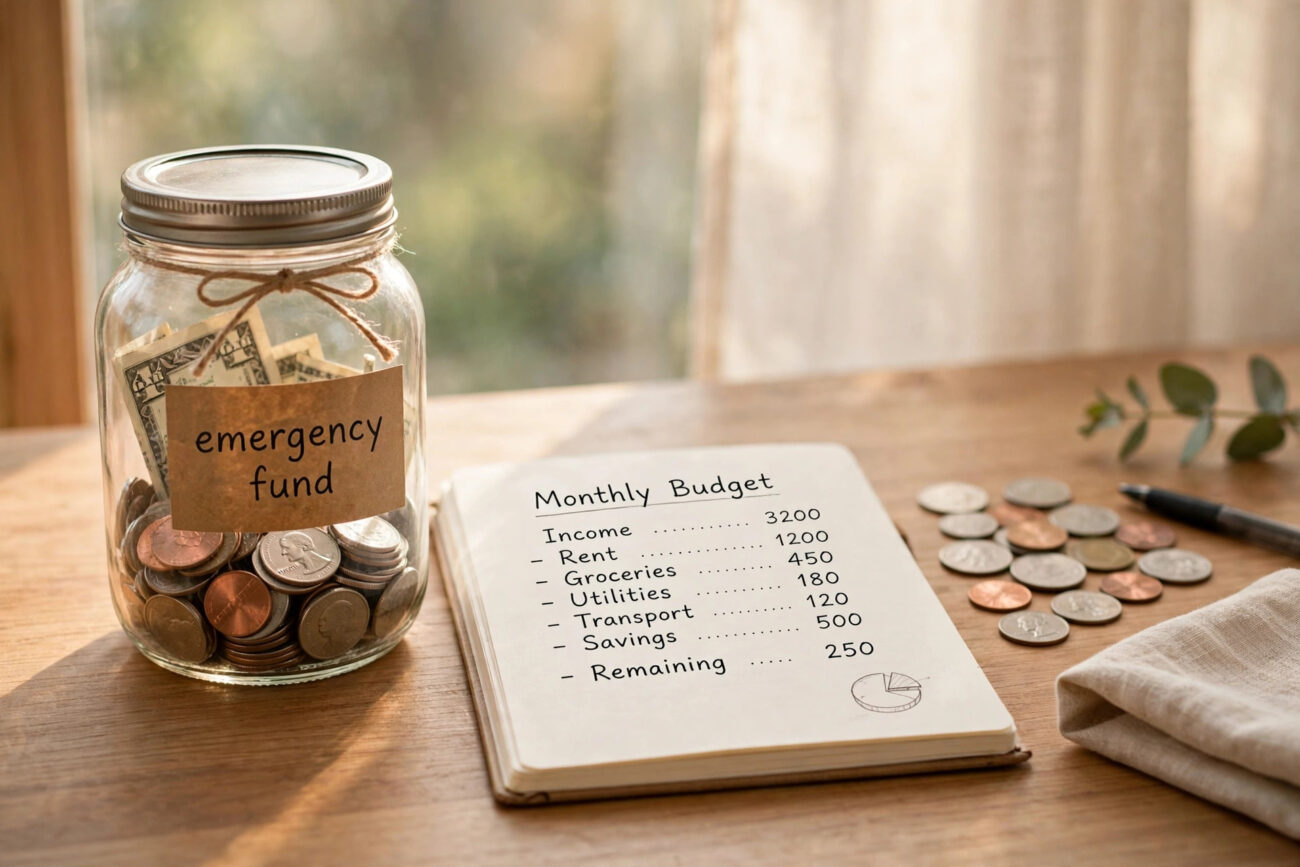
A car repair, a medical bill, or a sudden job loss can turn a normal month into a financial crisis, and that is exactly what an emergency fund is for. So what is an emergency fund and how much should I save? An emergency fund is a cash reserve set aside for unexpected, necessary, and urgent costs, kept in a safe place where you can reach it quickly. The standard target is 3 to 6 months of essential expenses, with a starter fund of $500 to $1,000 as the first milestone.
This guide explains what counts as a real emergency, how to work out your own number, where to keep the money, and how to build the fund on a tight budget. It also answers the question almost everyone asks first: should I pay off debt or save first? The short answer is both, in the right order, and this guide shows you how.
What Is an Emergency Fund?
An emergency fund is money you set aside for costs you did not plan for, cannot delay, and cannot avoid. It is not a savings account for a holiday, a new phone, or a sale you do not want to miss. It is the money that stops a bad week from becoming a debt spiral.
The test for whether a cost qualifies has three parts, and all three must be true. It must be unexpected, like a car breakdown rather than a yearly insurance bill you knew was coming. It must be necessary, like a medical bill or a broken furnace rather than a new television. And it must be urgent, like a repair you need this week rather than a purchase you could save for over months. A holiday fails all three tests. A burst pipe passes all three.
Real emergencies look like this: a medical bill or dental emergency, a car repair that keeps you from getting to work, a home repair like a leaking roof, a vet bill, or a sudden loss of income. Non-emergencies look like this: a holiday, a new bike, a sale, a wedding gift, or Christmas presents. Those are all real costs, but they are predictable, so they belong in a separate savings plan, not in the emergency fund.
The fund works because it turns a crisis into an inconvenience. Without it, a $1,000 car repair goes on a credit card at 20 percent interest or more, and the interest keeps costing you for months. With it, you pay the bill, feel the sting for a week, and rebuild the fund. That difference is the whole point.
How Much Should I Save in an Emergency Fund?
The widely used rule is 3 to 6 months of essential expenses, and the right number inside that range depends on your situation. Essential expenses are the costs you must pay to live: housing, utilities, groceries, transport, insurance, minimum debt payments, and medicines. They are not your total spending. Subscriptions, eating out, and entertainment do not count, because you can cut them in a crisis.
Start by adding up one month of essentials. For example, if your essentials are $2,500 a month, a 3-month fund is $7,500 and a 6-month fund is $15,000. That is the target. Now work out where you sit on the scale.
| Household Type | Suggested Target | Why |
|---|---|---|
| Single, stable job, low expenses | 3 months | One income but few commitments, quick to cut costs |
| Dual-income couple | 3 to 4 months | Two incomes reduce the risk of both stopping at once |
| Single-income family | 6 months | One income supports the whole household |
| Self-employed or variable income | 6 to 9 months | Income is irregular and work can dry up suddenly |
| Single parent | 6 to 9 months | One income plus dependants, with little flexibility |
| Just starting out | $500 to $1,000 starter fund | Covers most small emergencies while you build up |
Do not let the big number put you off. Almost nobody saves $15,000 in one go. The fund is built in stages: first $500, then $1,000, then one month of essentials, then three, then six. Each stage is a real achievement, and even the starter fund covers the most common emergencies, which are usually under $1,000.
Where Should I Keep My Emergency Fund?
An emergency fund must be safe, liquid, and separate. Safe means the balance cannot fall when you need it, so never put it in stocks, crypto, or any investment that can drop in value. Liquid means you can reach it within 24 to 48 hours, so a fixed-term deposit that locks the money away is the wrong place. Separate means it sits in its own account, away from everyday spending, so you are not tempted to dip into it for non-emergencies.
The best place for most people is a high-yield savings account. These accounts pay far more interest than a standard savings account, and the money is still available within a day or two. As of early 2026, many high-yield savings accounts pay around 4 percent APY or more, while the national average for a standard savings account is about 0.39 percent, according to Experian. On a $10,000 fund, that difference is roughly $360 a year in interest, which is a meaningful bonus for money that is just sitting there. NerdWallet’s emergency fund guide explains the same rule and how to pick an account.
A money market account is a reasonable alternative, and it works the same way. A standard checking account is not ideal, because the money is too easy to spend, and it earns almost no interest. Cash at home is the worst option: it earns nothing, it is not protected if it is lost or stolen, and it is too easy to spend on something that is not an emergency.
How to Build an Emergency Fund on a Tight Budget
The most common reason people do not have an emergency fund is that they feel they cannot afford one. The trick is to make the saving automatic and small enough that you do not feel it.
- Start with $25 or $50 a week. At $50 a week, you reach $1,000 in 20 weeks and $2,600 in a year. Small amounts add up faster than most people expect.
- Automate it. Set up an automatic transfer on payday, so the money moves before you can spend it. Treat it like a bill you owe yourself.
- Save windfalls first. Tax refunds, work bonuses, and cash gifts go straight to the fund until it is full. This is the fastest way to build it.
- Cut one subscription. Cancel one streaming service or delivery membership and redirect that money. It is a small sacrifice with a clear purpose.
- Round up spare change. Many banking apps round purchases up to the nearest dollar and save the difference. It is slow, but it is effortless.
- Sell something you do not use. A first sale of $100 or $200 gives the fund a real start and proves to yourself that you can do it.
Set a monthly target and a date to reach the starter fund, then a date for one month of essentials. A written target with a date is far more effective than a vague intention to save more. And when you have to use the fund, do not feel guilty. That is what it is for. The only job afterwards is to rebuild it, starting with the same small automatic transfer.
Should I Pay Off Debt or Save First?
This is the question that stops many people from starting, and the answer is to do both, in order. First, save a starter fund of $500 to $1,000. Then focus on paying down high-interest debt, like credit cards. Then, once the expensive debt is gone, build the fund up to 3 to 6 months of essentials.
The order matters. Without a starter fund, every small emergency goes straight onto a credit card, and the debt grows again. With a starter fund, a $600 car repair is paid in cash and the debt plan stays on track. The starter fund protects the debt plan.
Low-interest debt, like a mortgage or a student loan with a low rate, is different. There is no need to pay those off before building the full fund. Pay the minimums, build the fund, and then decide whether extra payments or extra savings serve you better. And if your employer offers a retirement match, take the full match first, because that is free money you cannot get back later.
When Should I Use My Emergency Fund?
Use it only for true emergencies, the ones that pass the three-part test: unexpected, necessary, and urgent. A job loss, a medical bill, a car repair that keeps you from work, or a burst pipe all qualify. A holiday, a sale, a new phone, or a wedding gift do not.
When you do use it, use only what the emergency costs, not the whole fund. If the repair is $800 and the fund holds $2,000, take $800 and leave the rest working. Then rebuild what you spent before you move on to other savings goals. Rebuilding is part of the habit, not a punishment for using the money.
It also helps to write down your own rules in advance. Decide now what counts as an emergency for your household, and agree it with your partner if you share finances. In the middle of a crisis, when stress is high, a rule you wrote on a calm day is much easier to follow than a decision made on the spot.
FAQs About Emergency Funds
What is an emergency fund?
An emergency fund is a cash reserve for unexpected, necessary, and urgent costs, like a medical bill, a car repair, or a job loss. It is kept in a safe, accessible account, separate from everyday spending, so it is there when you need it and not spent on anything else.
How much should I save?
Start with $500 to $1,000, then build to 3 to 6 months of essential expenses. A single person with a stable job can aim for 3 months. A single-income family, a single parent, or someone self-employed should aim for 6 months or more. Essentials are housing, utilities, groceries, transport, insurance, minimum debt payments, and medicines.
Where should I keep it?
In a high-yield savings account, separate from your everyday spending. It stays safe, it earns interest of around 4 percent APY or more in early 2026, and you can reach it within 24 to 48 hours. Do not put it in stocks or crypto, where the value can fall when you need it most.
Should I pay off debt or save first?
Save a starter fund of $500 to $1,000 first, then pay down high-interest debt, then build the fund to 3 to 6 months. The starter fund stops small emergencies from going back on a credit card and undoing your debt plan.
When should I use it?
Only for true emergencies: unexpected, necessary, and urgent costs like a medical bill, a car repair, or a job loss. Use only what the emergency costs, then rebuild the fund. A holiday, a sale, or a new phone is not an emergency, even if it feels urgent at the time.
Is 3 months enough?
It depends. For a stable dual-income household, 3 months is a reasonable target. For a single income, a variable income, or a household with dependants, 6 months or more is safer. The right number is the one that lets you sleep at night if your income stopped tomorrow.
Conclusion
An emergency fund is the simplest and most powerful financial habit there is. Start with $500 to $1,000, keep it in a high-yield savings account where it is safe and reachable, and build toward 3 to 6 months of essential expenses at a pace your budget can sustain. Pay off expensive debt after the starter fund is in place, and use the fund only for true emergencies, then rebuild it. You cannot predict the next crisis, but you can decide today whether it becomes a setback or a disaster. Open the account this week, set up the automatic transfer, and give your future self that safety net.
