
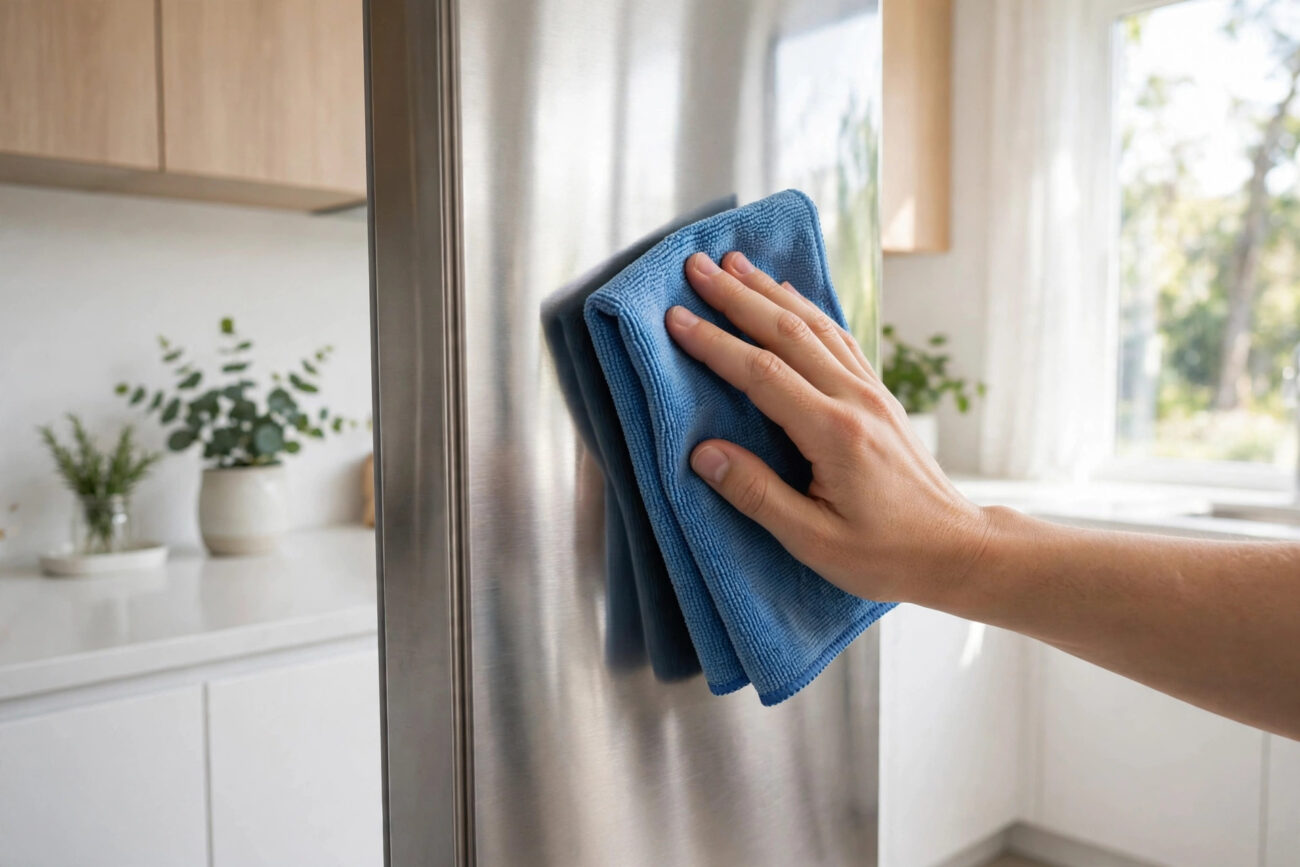
You wipe the fridge, step back, and the streaks are still there. Learning how to clean stainless steel appliances without streaks is less about buying a special spray and more about understanding why streaks appear in the first place. Most streaks come from three simple causes: wiping across the grain, leaving soap or cleaner behind, or letting water dry on the surface. Fix those three things and a fridge door can go back to a soft, even shine in a few minutes.
In this guide, you will learn what the grain is and how to find it, the daily wipe that keeps appliances clean, a deeper weekly routine for grease and fingerprints, and how to handle tough spots like hard water marks and small scratches. You will also learn which products to avoid, how coated and black stainless finishes differ, and what to do when streaks seem permanent. The method uses warm water, mild dish soap, and microfiber cloths, and it works on fridges, ranges, dishwashers, and microwaves.
What Is Stainless Steel, and Why Does It Streak?
Stainless steel is steel that resists rust because of a thin chromium oxide film on its surface. That film protects the metal, but it also shows every fingerprint, water spot, and smear. Most appliance panels are brushed stainless steel, which means the surface has very fine parallel lines, called the grain, a bit like the grain in wood.
Streaks form when cleaning residue, grease, or mineral-filled water settles into those fine lines unevenly. Wiping in circles or across the grain pushes residue into the lines in different directions, which catches the light as streaks. Using too much product makes it worse, because the leftover film dries into a cloudy haze. Hard water adds another layer: when rinse water dries on the panel, the minerals stay behind as spots.
The good news is that none of this is damage. A streaky panel is almost always a cleaning problem, not a broken finish, and the fix is a better routine rather than a stronger chemical.
Find the Grain First
Before you clean anything, find the grain. Stand close to the appliance and look at the surface at an angle, with light coming across it. You will see very fine parallel lines. On most fridges and dishwashers, they run vertically or horizontally. If you cannot see them, run a fingertip lightly in two directions. One direction will feel smoother. That is the grain.
From now on, every wipe and every buff goes in that direction, in long, straight strokes from one edge to the other. No circles, no zigzags. It feels almost too simple, but it is the reason professional cleaners get streak-free results with nothing more than soap and water.
Some surfaces, like very smooth polished stainless or many coated finishes, have no visible grain. On those, choose one direction and stick to it for the whole panel so the finish stays even.
What You Will Need
A small, good kit does it all. You do not need a shelf of specialty products, and buying more bottles usually makes streaks worse, not better.
- Two or three microfiber cloths: one damp for cleaning, one dry for drying, and one for buffing. Keep a set in one color for stainless only, so they stay free of other residues.
- Mild dish soap: a gentle soap without added lotions or bleach. A teaspoon in a quart of warm water is enough.
- Warm water: plain tap water for washing, plus a clean damp cloth for a rinse wipe.
- White vinegar (optional): only for hard water spots on traditional stainless, wiped off right away. Never use it on coated finishes unless your manual allows it.
- Baking soda (optional): a paste for cooked-on grime on traditional stainless only.
- A dedicated stainless steel cleaner (optional): for traditional stainless only, as a final polish step, never as a daily cleaner.
Wash microfiber cloths without fabric softener, which clogs the fibers, and air-dry them or tumble on low. A clean cloth is half of a streak-free finish. A cloth that has picked up grease or grit from other jobs will smear the panel no matter how careful you are.
The Daily Wipe: Two Minutes, No Streaks
For everyday fingerprints and light smudges, the simplest method still wins. Do this after dinner, when the kitchen is already in clean-up mode, and the panel will rarely need a deeper clean.
- Dampen a microfiber cloth with warm water and a drop of dish soap. Wring it out well. The cloth should be damp, not dripping.
- Wipe with the grain in long, straight passes from one edge to the other. Use light, even pressure.
- Rinse the cloth in plain warm water, wring it out, and wipe the panel again to remove any soap left behind. Soap residue is one of the main causes of streaks.
- Dry immediately with a clean, dry microfiber cloth, still along the grain. Do not let the water air-dry, or mineral spots will set.
That final dry buff is the step most people skip, and it is the step that makes the difference. Streaks that looked permanent often turn out to have been water all along, and they vanish with a thorough dry buff.
The Weekly Deep Clean for Grease and Grime
Once a week, or whenever the panel looks dull, give it a fuller clean. This routine handles cooking grease, sticky fingerprints, and the haze that builds up over days of quick wipes.
- Remove loose dust with a dry microfiber cloth, wiping with the grain.
- Wash with soapy water: a teaspoon of mild dish soap in a quart of warm water, applied with a damp microfiber cloth, wiping with the grain in straight passes.
- Rinse with a plain-water wipe using a fresh damp cloth, so no soap stays on the surface.
- Dry completely with a dry microfiber cloth, buffing along the grain until the panel is fully dry.
- Optional polish: on traditional, uncoated stainless only, apply a small amount of dedicated stainless steel cleaner to a cloth, not directly to the panel, and buff with the grain. Use it sparingly. A little goes a long way, and too much leaves the haze you are trying to remove.
Work one panel at a time, and finish each panel before moving on. Letting a washed panel sit wet while you clean the next one is how water spots form.
Finish Types: Not All Stainless Is the Same
The biggest mistake in stainless care is treating every finish the same. Check your appliance manual before using any product beyond soap and water, because the manual wins over any general tip, including this one.
| Finish | Daily cleaning | What to avoid |
|---|---|---|
| Traditional brushed stainless | Warm water, mild dish soap, microfiber, dry buff | Steel wool, bleach, abrasive pads, gritty cloths |
| Fingerprint-resistant (coated) | Warm water, mild soap, soft cloth only | Stainless steel cleaners, vinegar, window spray, polish |
| Black stainless | Warm water, mild soap, soft cloth, gentle dry buff | Stainless steel cleaners, abrasive pads, ammonia cleaners |
| Polished or smooth stainless | Warm water, mild soap, soft cloth, one-direction wiping | Abrasive pads, scouring powder, steel wool |
Fingerprint-resistant and black stainless finishes are often coated surfaces, not bare metal. Manufacturers such as Whirlpool and KitchenAid tell owners to wash these doors with mild soap and warm water only, then dry thoroughly. GE goes further on some models and warns against vinegar, window sprays, ammonia, and even stainless steel cleaners on fingerprint-resistant or black stainless finishes. If your manual says no to a product, trust the manual.
How to Handle Tough Spots
Some marks need more than a daily wipe. Here is how to handle each one without damaging the finish.
Hard Water Spots and Mineral Marks
Hard water spots come from minerals left behind when water dries on the panel. On traditional stainless, dampen a cloth with a little white vinegar, wipe with the grain, then rinse with plain water and dry right away. In hard-water areas, drying the panel every time is the real fix, because prevention beats removal. Never use vinegar on a coated or black stainless finish unless the manual allows it.
Cooked-On Grease
For sticky grease near a range, make a paste of baking soda and a little water. Apply it with a soft cloth, working with the grain, and let it sit for a few minutes before wiping it away with a damp cloth. Rinse with plain water and dry. Baking soda is mildly abrasive, so use it only on traditional stainless and only with a soft cloth, never a scouring pad.
Small Rust Spots and Tarnish
Small rust spots on traditional stainless can come from a stray bit of steel wool, a metal can left on the surface, or a scratch that exposed bare metal. An oxalic-acid cleanser such as Bar Keepers Friend Soft Cleanser, applied with a soft cloth and wiped with the grain, usually removes them. Rinse well and dry. If rust keeps coming back in the same spot, the protective film may be damaged, and a technician should take a look.
Light Scratches
Light surface scratches on brushed stainless can sometimes be softened by buffing with the grain using a non-abrasive stainless cleaner and a microfiber cloth. Deep scratches cannot be wiped away, and aggressive buffing usually makes them more visible. For a deep scratch on a visible panel, ask the manufacturer or a repair technician about professional refinishing before trying anything stronger.
Appliance-by-Appliance Tips
Each appliance has its own trouble spots. A few small adjustments make the routine fit the machine.
- Refrigerator: the door is the biggest panel in most kitchens and the one everyone touches. Clean the handles first, then the door, so grease from the handles does not transfer back onto a clean panel. Check the grain direction, which often runs vertically on fridge doors.
- Range and oven: wipe the front after cooking, once the surface is cool. Grease sets harder when it sits overnight. Keep oven cleaner and stovetop sprays away from stainless trim, since many contain chemicals that stain it.
- Dishwasher: the front panel collects water spots from the sink nearby. A quick dry buff after the daily wipe keeps it even. Wipe around the control panel gently and never spray cleaner directly onto buttons or displays.
- Microwave: the door and trim are smaller, so use a barely damp cloth and dry right away. Food splatter inside the door edge should be wiped with warm soapy water, not a stainless cleaner.
Costs: What Streak-Free Cleaning Really Costs
You do not need an expensive kit. Here are typical price ranges in the United States for the supplies that matter.
- Microfiber cloths (pack of 12): typically 8 to 15 dollars
- Mild dish soap: typically 3 to 6 dollars, and a bottle lasts months
- White vinegar: typically 3 to 5 dollars per gallon
- Baking soda: typically 1 to 3 dollars per box
- Dedicated stainless steel cleaner: typically 6 to 12 dollars per bottle
- Bar Keepers Friend Soft Cleanser: typically 4 to 7 dollars
The daily routine costs almost nothing, since it uses soap and water you already own. That is the point: streak-free stainless is a technique problem, not a shopping problem. Keeping the rest of the home in good shape matters too, and seasonal jobs like protecting your pipes pair well with a kitchen reset. See our guide on how Piedmont Natural Gas is powering homes and businesses more efficiently for more home efficiency ideas.
Five Mistakes That Cause Streaks and Scratches
- Wiping against the grain. Those faint lines set the direction of every wipe. Whirlpool’s guides state the rule plainly: always wipe in the direction of the grain to avoid streaks.
- Using a scouring pad or steel wool. Whirlpool warns that damage may occur to stainless steel surfaces even with one-time or limited use of abrasive pads. GE’s manuals say the same thing in plainer words: do not use a steel wool pad, because it will scratch the surface.
- Using bleach or ammonia cleaners. Multi-purpose cleaners that contain bleach or ammonia can stain and dull stainless steel, and GE rules out appliance wax, polish, bleach, and products containing chlorine on stainless steel.
- Spraying stainless cleaner on a coated finish. Fingerprint-resistant and black stainless finishes are often coated, and stainless steel cleaners can damage that coating. Mild soap and water is the whole routine for those finishes.
- Leaving the panel wet. Water spots form when rinse water dries on the panel. Always finish with a dry microfiber buff, along the grain, until the surface is fully dry.
Frequently Asked Questions
What is the best way to clean stainless steel appliances without streaks?
Wash with warm water and a teaspoon of mild dish soap using a soft microfiber cloth, wipe in the direction of the grain, rinse with a plain-water wipe, and dry the panel completely with a dry cloth. Streaks come from wiping across the grain, soap left behind, or water drying in place, so the rinse and the dry buff matter as much as the wash.
Can I use vinegar on stainless steel appliances?
On traditional, uncoated stainless steel, yes, for hard water spots, but wipe it off right away and rinse with plain water. On fingerprint-resistant or black stainless finishes, usually no. KitchenAid lists vinegar among the things never to use on some finishes, and GE warns against it on coated doors, so check your manual first.
Do I need a special stainless steel cleaner?
No, not for daily cleaning. Warm water and mild dish soap handle daily messes better than specialty products on most appliances. A dedicated stainless steel cleaner is an optional final polish step on traditional stainless only, and it should never be used on fingerprint-resistant or black stainless finishes.
Can I use paper towels on stainless steel?
Plain paper towels are not ideal. Rough or gritty paper towels can leave fine scratches, and they tend to shed lint that shows up as streaks. A soft microfiber cloth is safer and cheaper over time, since you can wash and reuse it hundreds of times.
How do I stop fingerprints on stainless steel?
You cannot stop fingerprints entirely, but a daily wipe with a damp microfiber cloth and a dry buff keeps them from building up. On a fingerprint-resistant finish, that simple routine is the whole answer. Avoid oily polishes, which attract more prints and leave a film that streaks in bright light.
Why does my stainless steel look cloudy after cleaning?
A cloudy look usually means cleaner or soap was left on the surface, or that water dried in place and left minerals behind. Fix it with a plain-water wipe followed by a thorough dry buff along the grain. If the cloudiness stays, repeat the wash with fresh soapy water and rinse more carefully, because old residue is often the cause.
Related Reading
- How Piedmont Natural Gas Is Powering Homes and Businesses More Efficiently
- Top Features of Samsung Password Manager You Should Know
Conclusion
Streak-free stainless steel comes down to a short routine: find the grain, wash with warm soapy water, rinse, and dry completely along the grain. Skip the scouring pads, skip the bleach cleaners, and never use a stainless steel cleaner on a coated finish. Do the two-minute daily wipe, give the panels a weekly deep clean, and your appliances will keep the soft, even shine they had on showroom day. For manufacturer-backed guidance by finish type, see the guide to cleaning stainless steel appliances by finish.
