
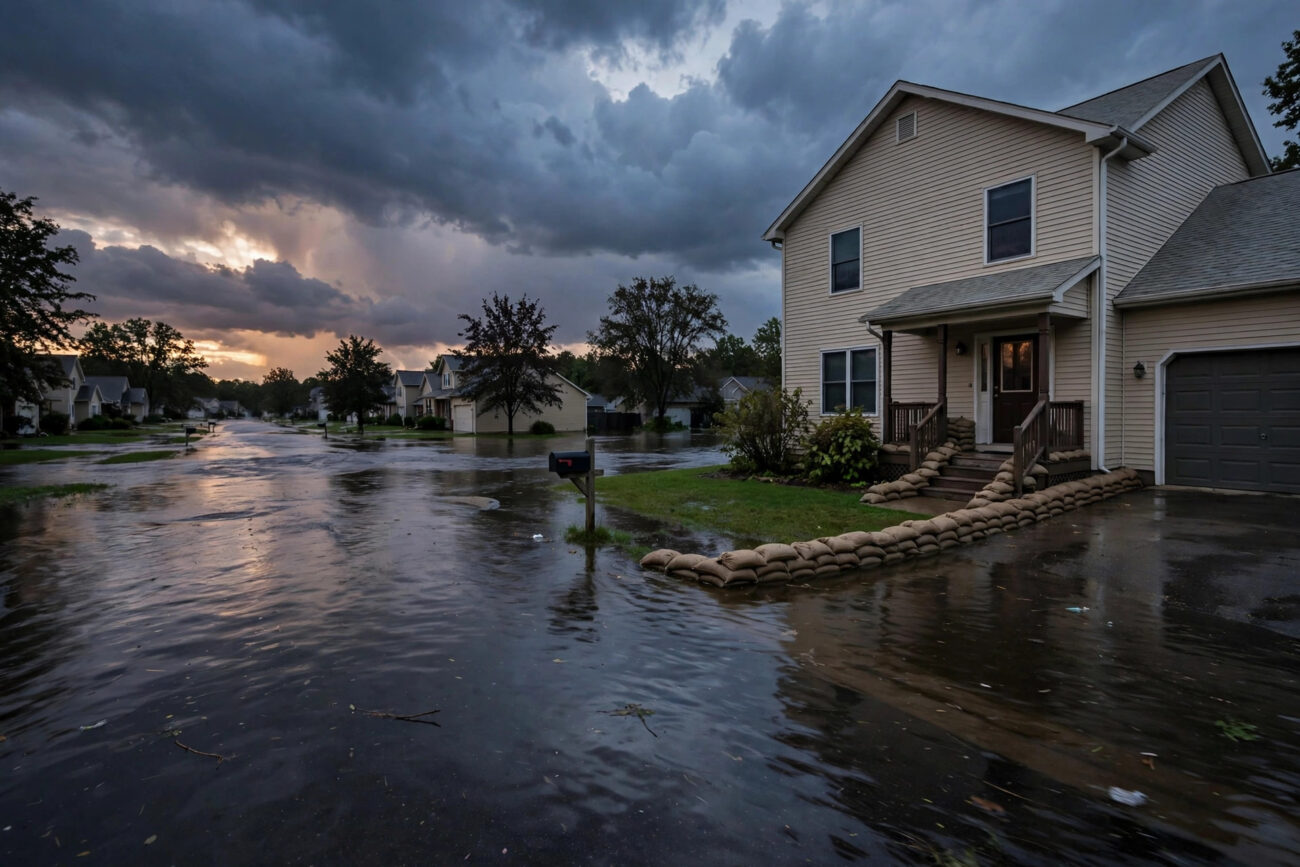
Just one inch of floodwater can cause up to $25,000 in damage to a home, and here is the part that catches millions of homeowners by surprise: your standard homeowners insurance will not pay for any of it. Flood insurance is the separate policy that covers damage from rising water, and if you wait until a storm is forecast to buy it, you have already waited too long. In this guide, we answer the question “what is flood insurance and what does it cover”, explain how much it costs, when your lender requires it, and how to buy a policy before the water arrives.
What Is Flood Insurance?
Flood insurance is a separate insurance policy that pays to repair or replace property damaged by flooding, losses that standard homeowners and renters insurance almost never include. It covers damage caused by water that rises from outside your home: heavy rain, overflowing rivers, storm surge, flash floods, snowmelt, and levee or dam failure.
The federal government created the National Flood Insurance Program (NFIP) in 1968, and it is managed by the Federal Emergency Management Agency (FEMA). The NFIP is delivered through a network of more than 47 private insurance companies plus NFIP Direct, and today it covers about 4.7 million policyholders representing nearly $1.3 trillion in coverage. Private insurers also sell their own flood policies, which are growing in popularity as an alternative to the federal program.
Under the NFIP’s definition, a flood is a general and temporary condition where normally dry land is partially or completely underwater, affecting at least two acres of land or two or more properties. That definition matters at claim time: water damage from a burst pipe inside your home is a homeowners claim, not a flood claim, because the water did not come from outside. The general rule is that homeowners insurance covers water that comes from above or inside, a leaking roof or a burst pipe, while flood insurance covers water that comes from the ground up.
What Does Flood Insurance Cover?
An NFIP flood policy has two parts, building coverage and contents coverage, and contents coverage is bought separately from building coverage. Here is what each part typically covers:
| Feature | Building coverage (up to $250,000) | Contents coverage (up to $100,000) |
|---|---|---|
| What it may cover | The insured building and its foundation; electrical and plumbing systems; furnaces, water heaters, and central air conditioning; built-in appliances; permanently installed cabinets and paneling; attached structures and detached garages | Clothing, furniture, and electronics; curtains; portable and window air conditioners; washers and dryers; food freezers and the food in them |
| How it pays | Replacement cost value for a primary residence | Actual cash value (depreciated value), not replacement cost |
| Extra coverage | Debris removal, loss-avoidance measures such as sandbags, and the cost of moving property to safety before the flood | Valuable items such as artwork, collectibles, jewelry, and furs are capped at $2,500 per flood event |
Building coverage pays up to $250,000 for a residential property (up to $500,000 for commercial) to repair or replace the structure and its essential systems: the foundation, electrical wiring, plumbing, central air conditioning, furnaces, water heaters, and built-in appliances. It can also cover upgrades needed to comply with floodplain laws, such as elevating the structure or flood-proofing.
Contents coverage protects your belongings, furniture, clothing, electronics, portable appliances, up to $100,000 for residential policyholders ($500,000 for businesses). Two details matter: contents are paid at actual cash value, the depreciated value of a ten-year-old sofa rather than the price of a new one, and high-value items are capped at $2,500 per flood event for artwork, jewelry, collectibles, and similar items. If you own valuables, you may need separate scheduled coverage.
Basement coverage is limited. NFIP policies cover only certain items in a below-grade basement: the furnace, water heater, washer and dryer, air conditioner, food freezer, and food inside it, plus electrical and plumbing systems. Finished basement walls, flooring, and personal belongings stored below grade are generally not covered. If your basement is finished living space, this gap matters.
What Flood Insurance Does Not Cover
Flood insurance is narrower than most people expect. The following are generally not covered under an NFIP policy:
- Temporary housing and additional living expenses while your home is repaired. If you must live elsewhere for months, that cost is yours, unless you buy a private policy that includes it.
- Property outside the building: decks and patios, fences, seawalls, hot tubs and pools, landscaping, wells, and septic systems.
- Vehicles. Flood damage to a car is covered by the comprehensive portion of an auto insurance policy, not by flood insurance.
- Business interruption losses and lost income, for commercial properties.
- Mold damage resulting from a flood is not covered under NFIP policies, regardless of whether the mold was preventable.
- Moisture, mildew, or damage that could have been avoided by the property owner, and damage from sewer or drain backups, unless you add a specific endorsement.
- Currency, precious metals, and stock certificates stored in the home.
- Damage below grade beyond the limited list: finished basement walls, floors, and stored belongings.
Private flood policies sometimes cover some of these gaps, notably additional living expenses and higher limits, which is one reason to compare them against the NFIP before you buy.
How Flood Insurance Works
The 30-day waiting period is the most important thing to know. NFIP policies do not take effect the day you buy them, coverage starts 30 days after purchase. Buying a policy when a hurricane is already forecast means waiting too long. Narrow exceptions apply when a lender requires the policy at a home purchase.
How to buy. Start at FloodSmart.gov, the NFIP’s official site, or talk to your current home insurer or an independent agent, most standard insurers can write an NFIP policy. You will need your property address, the building’s details, and your FEMA flood zone, which you can look up free at FEMA’s Flood Map Service Center. Private flood policies are bought directly from private carriers or through the same agents, and some offer shorter waiting periods, sometimes as little as 10 to 14 days, and higher limits.
How a claim works. After a flood, document everything: photograph and video the damage before you clean up, and save receipts for emergency repairs and replacement purchases. The insurer sends an adjuster, and you file a proof-of-loss statement listing damaged items and their value. The average NFIP claim payout is about $68,000, according to FEMA data.
Flood zones determine your requirement and your price. FEMA maps every community into flood zones: A and V are high-risk (a 1 percent annual chance of flooding, about a 26 percent chance over a 30-year mortgage), B and X (shaded) are moderate risk, and C and X (unshaded) are minimal risk. Under FEMA’s Risk Rating 2.0 pricing, premiums also reflect your property’s elevation, distance to water, and rebuilding cost.
How Much Does Flood Insurance Cost?
There is no single price for flood insurance, it depends on your flood zone, your home’s elevation, the age of the building, and the coverage amount. National averages put the typical NFIP premium at roughly $900 to $1,300 a year. State averages range from roughly $720 in North Dakota to over $1,900 in West Virginia; FEMA data put the average policy in Florida at about $865 a year and in Louisiana at around $1,170.
Typical annual ranges by flood zone look like this:
- High-risk zones (A, AE): typically $800 to $2,500 a year, with some properties higher.
- Coastal high-risk zones (V): typically $1,200 to $3,500+ a year, the highest risk category.
- Moderate-risk zones (B, X shaded): typically $400 to $900 a year.
- Low-risk zones (C, X unshaded): typically $300 to $700 a year, with Preferred Risk Policies sometimes lower still.
Under Risk Rating 2.0, FEMA no longer prices mainly by zone. Your premium now reflects the specific risk of your property: its elevation relative to nearby water, its distance from a river or coastline, the type of flooding it faces, and the cost to rebuild it. Two houses in the same zone can pay very different premiums. Private insurers price differently again, some are cheaper than the NFIP for low-risk homes, and some offer higher coverage limits for high-value properties that exceed the NFIP’s $250,000 building cap.
Ways to lower your premium include raising your deductible, elevating utilities above the base flood elevation, and installing flood vents. Treat every figure here as a ballpark range, not a quote: get a written quote for your own property.
NFIP vs. Private Flood Insurance
Homeowners have two main options: the federally backed NFIP or a private flood insurer. Here is how they compare:
- Coverage limits. The NFIP caps residential building coverage at $250,000 and contents at $100,000. Private insurers can offer much higher limits, which matters for high-value homes.
- Additional living expenses. The NFIP does not cover temporary housing while your home is repaired. Many private policies do.
- Waiting period. NFIP policies typically carry a 30-day waiting period; private policies often start in 10 to 14 days.
- Price. For high-risk properties, the NFIP is often competitive; for low- and moderate-risk homes, private insurers are frequently cheaper.
- Availability. The NFIP is available in participating communities nationwide, while private flood insurance is offered in most states but not all, and availability varies by carrier.
- Stability. The NFIP’s authorization is set by Congress and currently runs through December 11, 2026. If it lapses, FEMA would stop selling and renewing policies, though existing policies and claims would continue. Private policies are not affected.
For many homeowners, the practical approach is to price both. Get an NFIP quote and at least one private quote, compare the limits and the exclusions, especially additional living expenses and contents paid at replacement cost versus actual cash value, and choose the combination that fits your home’s value and your budget.
Do You Need Flood Insurance?
For some homeowners, flood insurance is mandatory. If your home is in a high-risk flood zone (a Special Flood Hazard Area, zones A or V) and you have a mortgage from a federally regulated or insured lender, or a loan guaranteed by the FHA, VA, or USDA, your lender is required to make you carry flood insurance. The required amount is the lowest of three numbers: your loan balance, the home’s replacement cost, or the NFIP maximum of $250,000 for the building. You are also required to carry it if you previously received federal disaster assistance for flood damage.
For everyone else it is optional, but worth seriously considering. FEMA’s numbers show roughly one in four flood claims comes from properties outside the high-risk zones, and flooding is the most common natural disaster in the United States. Heavy rain, overwhelmed storm drains, and flash floods can damage homes far from any mapped floodplain.
A practical way to decide: check your flood zone on FEMA’s Flood Map Service Center, look at your property’s elevation and drainage, and consider your history, has your street ever held standing water? Has a neighbor flooded? If the answer to any of those is yes, or if a $25,000 repair bill would strain your finances, a policy costing a few hundred dollars a year in a low-risk zone is cheap protection. Protecting your home’s systems matters beyond insurance too, our guide to how Piedmont Natural Gas powers homes more efficiently covers the utility systems that floodwater threatens first, and staying informed during severe weather helps as well; see our guide on understanding iOS emergency alerts for setting up flood and weather warnings on your phone.
One final warning: buy before you need it. The 30-day NFIP waiting period means a policy bought today does not protect you this month. The best time to buy flood insurance is on a dry, sunny day, when it feels least necessary.
Frequently Asked Questions
Does homeowners insurance cover flooding?
No. Standard homeowners insurance policies explicitly exclude flood damage, this is one of the most common misconceptions among homeowners. Homeowners insurance covers water damage from burst pipes or appliance leaks, but not flooding from external sources such as storms, rising rivers, or storm surge. You need a separate flood insurance policy through the NFIP or a private insurer.
Is flood insurance required when I get a mortgage?
It is required if the home is in a FEMA high-risk zone (any zone starting with A or V) and your loan is federally backed or sold to Fannie Mae or Freddie Mac, which covers most mortgages. It is also required if you previously received federal disaster assistance for flood damage. Outside high-risk zones, it is not legally required, but a lender can still choose to require it.
How long is the waiting period for flood insurance?
NFIP policies typically have a 30-day waiting period before coverage takes effect. There are narrow exceptions, such as when a policy is required by a lender at a home purchase. Private flood policies often have shorter waiting periods of 10 to 14 days.
Does flood insurance cover basements?
Only partially. NFIP policies cover certain items in a below-grade basement, the furnace, water heater, washer and dryer, air conditioner, food freezer and the food inside it, and electrical and plumbing systems. Finished basement walls, flooring, and personal belongings stored below grade are generally not covered.
Can renters buy flood insurance?
Yes. Renters can buy contents-only flood insurance through the NFIP or a private insurer to protect their belongings, even if they do not own the building. The building coverage belongs to the landlord.
How much does flood insurance cost if I am not in a flood zone?
In low-risk zones, NFIP premiums typically run $300 to $700 a year, and Preferred Risk Policies can be even lower. Private insurers are often cheaper still for low-risk homes. Given that about one in four flood claims comes from outside high-risk zones, low-risk coverage is often the best value in the program.
Conclusion
Flood insurance is the separate policy that pays when rising water damages your home and belongings, something your homeowners insurance will not do. Through the NFIP, you can insure a home for up to $250,000 and contents for up to $100,000, with private insurers offering higher limits and extras like temporary housing coverage. It costs roughly $900 to $1,300 a year on average nationally, and far less in low-risk zones. The two things to remember: flood insurance is mandatory if you have a federally backed mortgage in a high-risk zone, and the NFIP’s 30-day waiting period means you cannot buy protection when a storm is already on the way. If there is any chance of water reaching your home, buy it on a dry day.
This article is general information, not licensed insurance advice. Policy terms vary by insurer and state, always read your policy and confirm details with a licensed agent or your state insurance department.
Related Reading
- How Piedmont Natural Gas Is Powering Homes and Businesses More Efficiently
- Understanding iOS 26.2 Emergency Alerts and How to Customize Them
- Liberty High School Gas Evacuation Sparks Safety Concerns Among Parents
Sources: SoFi, What Does Flood Insurance Cover?; Insurance.com, What Is Flood Insurance and What Does It Cover?
