
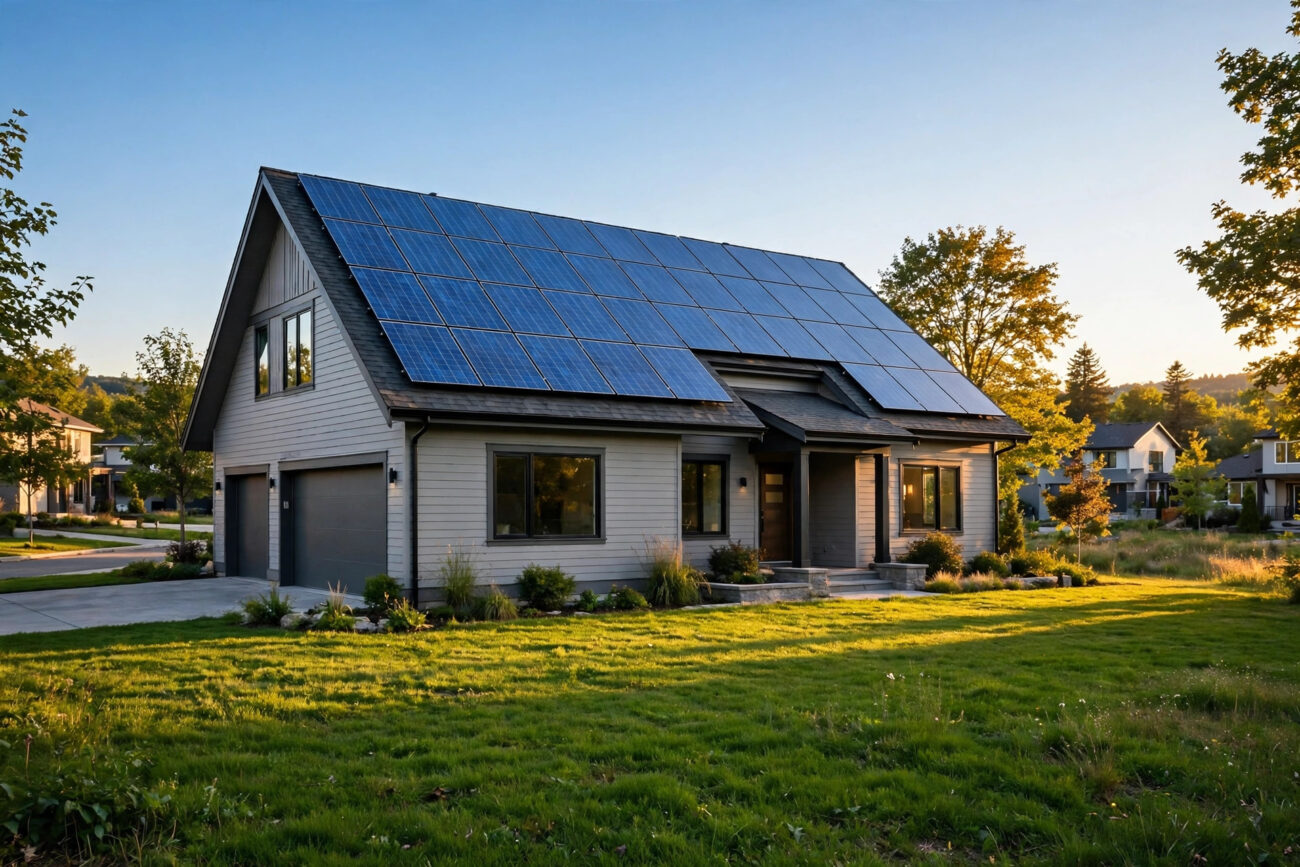
Solar panels used to be a luxury purchase for early adopters. In 2026 they are a mainstream home upgrade, and the question most homeowners ask first is a simple one: how much do solar panels cost? The short answer is that a typical residential system costs about $2.50 to $3.50 per watt installed, which works out to roughly $15,000 to $21,000 for a common 6 kW system before incentives, and about $25,800 for a 10 kW system. This guide breaks down what you actually pay per watt, what drives the price up or down, how the end of the federal tax credit changes the math, and whether solar is worth it for your home.
All figures below are typical 2026 US ranges from published marketplace data, mainly EnergySage and SolarReviews, and they are planning benchmarks, not quotes. Your price depends on your roof, your location, the equipment you choose, and how competitive your local installers are. Get three quotes before you decide, and compare them on dollars per watt, not just the headline total.
What Are Solar Panels and How Do They Work?
Solar panels are flat modules, usually mounted on a roof, that convert sunlight into electricity. Each panel contains photovoltaic cells, most often made of silicon, that produce direct current (DC) when sunlight hits them. An inverter converts that DC power into alternating current (AC), which is what your home runs on. Any electricity you do not use right away flows back to the grid, and depending on your utility and state rules, you earn credits for it through net metering or net billing.
A complete home system is more than panels. It includes the inverter, racking that holds the panels to your roof, wiring, safety disconnects, monitoring software, and the labor to install and connect it all. Panels themselves are only about 12 to 20 percent of the total installed cost. The rest is equipment, labor, permits, and the installer’s margin, which is why the price of a single panel tells you very little about what a system costs.
Most residential panels today are rated at 400 to 450 watts each, so a 6 kW system needs about 14 to 15 panels, and a 10 kW system needs about 22 to 25. Panels are warrantied for 25 years by most major brands, and they typically keep producing for 30 years or more, losing only a small amount of output each year.
How Much Do Solar Panels Cost in 2026?
The number that matters most is the installed cost per watt: total system price divided by system size. EnergySage marketplace data puts the 2026 median at about $2.62 per watt for solar-only systems, with typical quotes ranging from $2.50 to $3.30 per watt depending on region, roof complexity, and equipment. Independent 2026 pricing roundups such as ThePricer’s solar cost guide report the same band, roughly $2.60 to $3.03 per watt installed. Here is what that means at common system sizes, before incentives:
| System size | Typical panels | Gross installed cost | Cost per watt |
|---|---|---|---|
| 5 kW | 12 to 13 | $13,900 | $2.78 |
| 6 kW | 14 to 15 | $15,000 to $21,000 | $2.50 to $3.50 |
| 8 kW | 19 to 20 | $20,000 to $25,600 | $2.50 to $3.20 |
| 10 kW | 22 to 25 | $25,800 | $2.58 |
| 12 kW | 28 to 30 | $30,720 | $2.56 |
Two things stand out. First, bigger systems cost less per watt, because fixed costs like permits and the truck roll spread across more panels. Second, the panels themselves are cheap relative to the whole job: a single 400-watt panel costs roughly $200 as hardware, or about $0.40 to $0.70 per watt for mid-range brands. The rest of your bill is everything around the panel.
Battery storage is the biggest optional add-on. A home battery typically adds $10,000 to $15,000 installed, and it is worth considering if your utility has time-of-use rates, frequent outages, or weak net metering rules. It is not required, and many homeowners add it later.
What Affects Solar Panel Cost?
Your roof. A simple, south-facing roof with a moderate pitch is the cheapest install. Steep pitches, multiple roof faces, tile or slate roofing, and old roofs that need replacing first all push the price up. If your roof has less than 10 years of life left, most installers will tell you to replace it before adding panels, since removing and reinstalling panels later costs thousands.
Your location. Installed prices cluster around $2.50 to $3.20 per watt nationally, but labor rates, permit fees, and installer competition vary widely by state and city. States with strong solar markets and several competing installers usually quote lower than states with only one or two installers.
Equipment tier. Budget Tier 1 panels from brands like Jinko, LONGi, and Trina run about $0.25 to $0.40 per watt for the module alone. Mid-range brands like Q CELLS, Canadian Solar, and Silfab run $0.40 to $0.65. Premium panels from SunPower Maxeon, REC, and Panasonic run $0.65 to $1.20 per watt. A detailed breakdown of module prices by tier and brand shows why mid-range panels are the best value for most homes: premium panels are more efficient and carry stronger warranties, but the extra output rarely justifies the price gap on a typical roof.
System size and financing. Cash purchases are the cheapest way to buy solar, since loans add interest and leases add a middleman. If you finance, compare the total cost of the loan, not just the monthly payment, and be careful with dealer fees buried in solar loans, which can add 20 to 30 percent to the price.
Electrical upgrades. Older homes sometimes need a panel upgrade or new wiring before solar can be connected, which can add $1,000 to $3,000. Your installer should flag this during the site survey, not after you have signed.
The 2026 Change: The Federal Tax Credit Is Gone
The biggest change for 2026 buyers is that the 30 percent federal Residential Clean Energy Credit ended for new residential installations placed in service after December 31, 2025. A system completed in 2026 does not qualify just because you signed a contract or paid a deposit in 2025. That means the sticker price is now the net price for most homeowners, and state incentives are the only discounts left.
State and local incentives still exist in many places: property tax exemptions, sales tax exemptions, state rebates, and performance-based incentives such as SRECs in some states. Check your state’s program before you buy, and ask each installer to list every incentive they included in your quote, so you can compare quotes on the same basis. A quote that headlines a low net price may be spending incentive money you have not yet received, so always compare gross prices first.
Are Solar Panels Worth It?
For most homeowners with a suitable roof and a typical electricity bill, yes, but the payback now takes longer than it did when the federal credit existed. A system that costs $20,000 and saves you $1,500 a year on electricity pays for itself in about 13 years, then produces largely free power for another 12 to 17 years. Homes in sunny states with high electricity rates pay back fastest, often in 7 to 10 years. Homes in cloudy states with cheap electricity may take 15 years or more, and for some of them solar is a marginal investment.
To judge your own case, look at three numbers: your annual electricity spend, your roof’s sun exposure, and your utility’s net metering terms. A south-facing roof with little shade and a utility that credits exported power fairly is the ideal combination. A heavily shaded roof, or a utility that pays very little for exported power, weakens the case considerably. Running your own bill through a solar sizing calculator before you talk to installers gives you a realistic expectation, and it makes it much harder for a salesperson to oversell you a system that is too big.
Solar also adds value beyond the bill savings. Studies of home sales consistently find that owned solar systems add a modest premium to resale value, and buyers increasingly treat panels as a feature rather than a curiosity. Leased systems are a different story: they can complicate a sale, since the buyer must take over the lease. If you plan to sell within a few years, an owned system is the safer choice.
Buying vs Leasing Solar Panels: Pros and Cons
Buying with cash. Lowest total cost, full ownership, best resale value, and you keep every dollar of bill savings. The downside is the large upfront payment, typically $15,000 to $30,000.
Buying with a loan. No large upfront cost and you still own the system, but interest adds thousands to the total, and dealer fees can inflate the price. Compare the loan’s total cost, not the monthly payment.
Leasing or a power purchase agreement. Little or no money down and the installer handles maintenance, but you do not own the system, your savings are smaller, and a lease can complicate selling your home. For most homeowners, buying, with cash or a straightforward loan, beats leasing over the life of the system.
Solar Panel FAQs
How many solar panels do I need?
It depends on your annual electricity use. The average American home uses about 10,500 kWh per year, which a 6 to 8 kW system, or roughly 15 to 20 panels, can largely cover in a sunny region. Your installer should size the system from your actual utility bills, not from a rule of thumb, and be wary of any quote that sizes from your roof area alone.
How long do solar panels last?
Most panels carry a 25-year performance warranty and keep producing for 30 years or more. Output declines slowly, typically about 0.5 percent per year, so a panel still produces roughly 85 to 90 percent of its original output after 25 years. Inverters usually need replacing once during the life of the system, after 10 to 15 years.
Do solar panels work in winter or on cloudy days?
Yes, though output drops. Panels produce electricity from light, not heat, and they actually run more efficiently in cold weather. Snow usually slides off a tilted roof within a day or two, and cloudy days still produce 10 to 25 percent of a sunny day’s output. What matters most is your total annual sunlight, not any single season.
How much can you save with solar panels?
A typical homeowner saves $1,000 to $2,000 a year on electricity, depending on system size, local rates, and net metering rules. Over 25 years, total savings often reach $25,000 to $40,000, though the exact number depends heavily on how fast electricity prices rise in your area.
Do solar panels increase home value?
Owned systems usually add a modest premium, and homes with solar tend to sell faster in markets where buyers value low energy bills. Leased systems can have the opposite effect, since the buyer must assume the lease. If resale matters to you, own the system rather than leasing it.
What maintenance do solar panels need?
Very little. Rain usually keeps them clean enough, and most owners only need an occasional visual check and a cleaning once or twice a year in dusty areas. The main maintenance cost is the inverter, which typically needs replacing once after 10 to 15 years, at a cost of roughly $1,000 to $2,500.
Conclusion
Solar panels cost about $2.50 to $3.50 per watt installed in 2026, or roughly $15,000 to $21,000 for a typical 6 kW home system, and about $25,800 for a 10 kW system. With the 30 percent federal credit gone, the sticker price is now the price you pay, so state incentives and competitive quotes matter more than ever. Get three quotes, compare them per watt, size the system from your real electricity bills, and buy rather than lease if you can. Done that way, solar remains a solid long-term investment for most sunny, high-rate homes.
