
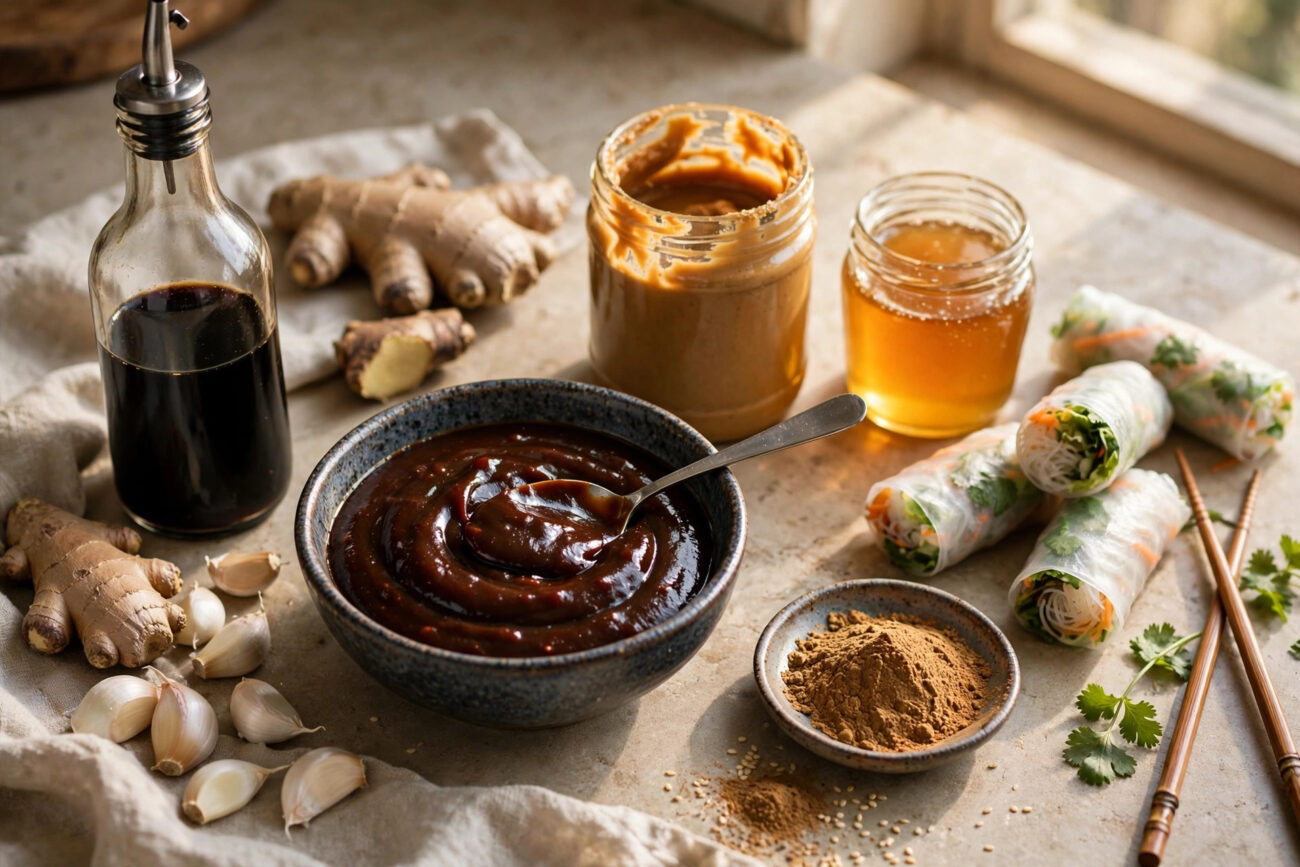
That thick, dark, sweet-savory sauce that comes with spring rolls and Peking duck is hoisin sauce, and the easy hoisin sauce recipe at home in this guide takes five minutes, uses pantry staples, and tastes better than most store-bought bottles. You do not need a special trip to an Asian grocery store, and you do not need to cook anything if you do not want to.
Below you will find the 5-minute no-cook version first, then a simmered upgrade that tastes closer to the traditional sauce, plus a substitution table for common missing ingredients, honest storage times, and answers to the questions people ask most about hoisin. Everything is measured in tablespoons and teaspoons, so you can scale it up or down without thinking.
What Is Hoisin Sauce?
Hoisin is a thick, sweet-savory condiment built on fermented soybean paste, and it is a staple of Cantonese cooking in particular. Its flavor is salty, sweet, and deeply savory all at once, with a background of garlic, chiles, and Chinese five-spice. It looks a little like a darker, denser barbecue sauce, but it tastes much more intense, so a little goes a long way.
The traditional base is fermented soybean paste, sugar, garlic, chiles, and five-spice, sometimes with vinegar for brightness. The version in most home kitchens uses peanut butter as a shortcut for the body and richness that soybean paste normally provides. Peanut butter is not traditional, but it works well, and it is the reason this recipe needs no cooking and no hard-to-find ingredients.
Hoisin shows up in many places: as a glaze for roast meats, stirred into noodles and rice, as a dipping sauce for spring rolls and dumplings, and spread inside wraps and lettuce cups. Once you have a jar in the fridge, you will find uses for it all week.
Easy Hoisin Sauce Recipe at Home: 5-Minute No-Cook Version
This is the recipe to start with. It makes about 1/2 to 1 cup depending on how you scale it, takes five minutes, and needs nothing more than a bowl and a whisk.
Ingredients:
- 1/4 cup soy sauce
- 2 tablespoons peanut butter, smooth
- 1 tablespoon honey
- 2 teaspoons rice vinegar
- 2 teaspoons sesame oil
- 1 clove garlic, finely grated or pressed
- 1 teaspoon miso paste
- 1 teaspoon gochujang or sriracha
Steps:
- Add the soy sauce, peanut butter, honey, rice vinegar, and sesame oil to a small bowl.
- Whisk until the peanut butter loosens and the mixture turns smooth and glossy, about one minute.
- Stir in the garlic, miso paste, and gochujang until fully combined.
- Taste and adjust: more honey for sweetness, more vinegar for brightness, more gochujang for heat.
- Use right away, or pour into a clean jar and refrigerate.
If the sauce feels too thick, whisk in a teaspoon of warm water at a time until it pours the way you like. If it feels too thin, add another teaspoon of peanut butter. The sauce thickens as it sits in the fridge, so stir it before each use. Keeping soy sauce, sesame oil, and the other staples together in one spot makes this a true five-minute recipe, and our guide to how to organize a small pantry on a budget shows how to group them so nothing is ever buried at the back of a shelf.
The Simmered Upgrade: 15 Minutes for Deeper Flavor
The no-cook version is excellent, but simmering the sauce for a few minutes gives it a deeper, rounder flavor that tastes closer to a traditional hoisin. Use this version when the sauce is the star, for example as a glaze on roast duck or pork, or as a dipping sauce you want guests to notice.
Ingredients:
- 1 tablespoon sesame oil
- 2 cloves garlic, minced
- 1 teaspoon fresh ginger, grated
- 1/4 cup soy sauce
- 2 tablespoons molasses or maple syrup
- 1 tablespoon rice vinegar
- 2 tablespoons peanut butter
- 1 teaspoon sriracha
- 1 teaspoon cornstarch mixed with 1 tablespoon water
- 1/4 teaspoon Chinese five-spice
Steps:
- Heat the sesame oil in a small saucepan over medium heat.
- Cook the garlic and ginger for 1 minute, until fragrant but not browned.
- Add the soy sauce, molasses, rice vinegar, peanut butter, sriracha, and five-spice, and stir until smooth.
- Pour in the cornstarch slurry and stir for 1 to 2 minutes until the sauce thickens and turns glossy.
- Remove from the heat and let it cool before using or storing. Total time is about 15 minutes.
The cornstarch slurry is what gives the simmered version its classic thick, spoon-coating texture. Add it slowly and keep stirring, because cornstarch clumps if it hits hot liquid all at once. If the sauce gets thicker than you like as it cools, whisk in a splash of warm water.
Hoisin Sauce Substitutions: What to Use When You Are Missing an Ingredient
Most kitchens are missing one or two of these ingredients, and almost every one has a workable swap. Use the table below before you give up on the recipe.
| Missing ingredient | Best substitute | Notes |
|---|---|---|
| Peanut butter | Dark miso plus 1 teaspoon tahini | Closest to the traditional soybean paste base, nut-free |
| Soybean paste or miso | Extra peanut butter, or black bean sauce | Skip the miso and add a pinch more garlic |
| Honey | Maple syrup or agave | Both swaps also make the recipe vegan |
| Rice vinegar | Apple cider vinegar, or white vinegar | Use a little less, both are sharper than rice vinegar |
| Sesame oil | Neutral oil plus 1/2 teaspoon toasted sesame seeds | You lose some aroma, the flavor still works |
| Gochujang or sriracha | Chili garlic sauce, or a pinch of red pepper flakes | Adjust to taste, flakes are hotter per teaspoon |
| Molasses | Maple syrup, brown sugar, or honey | Brown sugar needs a splash of water to dissolve |
| Five-spice | A pinch each of cinnamon, cloves, and star anise | Or skip it, the sauce still tastes like hoisin |
The gluten-free swap deserves its own note. Store-bought hoisin often contains wheat, because soy sauce and flour thickeners are standard in commercial recipes, so it is usually not gluten-free. Homemade hoisin is gluten-free only if you use tamari or a certified gluten-free soy sauce, so check the bottle before you pour. For a vegan version, swap the honey for maple syrup or agave, and check that your gochujang and miso are vegan, since a few brands add fish-based ingredients.
How to Store Homemade Hoisin Sauce
Storage times for homemade hoisin vary across recipes, so here is the honest range. In an airtight jar in the fridge, the no-cook version keeps for 1 to 2 weeks. The simmered version lasts a little longer, up to 3 weeks, because cooking kills off the bacteria that the raw garlic and fresh ingredients would otherwise feed. Sources disagree on the exact number, with some claiming up to a month, but 1 to 2 weeks is the safe range to plan around, and 3 weeks is the top end for cooked versions only.
For longer storage, freeze the sauce in ice cube trays, then move the cubes to a freezer bag. Frozen hoisin keeps for up to 3 months, and one cube is about the right amount for a stir-fry or a dipping bowl for two. Thaw cubes in the fridge overnight, or drop one straight into a hot pan, where it melts in seconds.
Two storage habits matter. First, always use a clean spoon, since a used spoon introduces bacteria that shortens the life of the whole jar. Second, stir before using, because the sauce thickens when cold and the oil can separate slightly on top. Neither is a sign that the sauce has gone bad. Throw it out only if it smells sour, shows mold, or tastes sharp in a way it did not when fresh.
What to Use Hoisin Sauce For
Hoisin is one of the most flexible sauces in the kitchen, and a single batch can cover a week of meals.
- Glaze for meats: brush it over roast chicken, pork tenderloin, or salmon in the last 10 minutes of cooking, when the sugars can caramelize without burning.
- Stir-fries: add 2 to 3 tablespoons to the pan with the vegetables and protein near the end, and toss until everything is coated.
- Noodles and rice: stir a spoonful through hot noodles or fried rice for instant sweet-savory depth.
- Dipping sauce: serve it straight with spring rolls, dumplings, and potstickers, or thin it with a little water and rice vinegar for a lighter dip.
- Wraps and lettuce cups: spread it inside wraps or spoon it over filling in crisp lettuce cups, which need no cooking at all. If you grow your own, our guide to how to grow lettuce indoors for beginners shows how to keep fresh leaves on hand all year.
- Marinades: mix hoisin with soy sauce and garlic as a quick marinade for chicken thighs or tofu, 30 minutes is enough.
The glaze use deserves a warning: hoisin contains sugar, so it burns if it goes on too early. For grilled or roasted meats, brush it on in the last stretch of cooking, not at the start.
Frequently Asked Questions
What is hoisin sauce made of?
Traditional hoisin is made from fermented soybean paste, sugar, garlic, chiles, and Chinese five-spice, sometimes with vinegar for brightness. Home versions often use peanut butter as a shortcut for the body and richness of the soybean paste, plus soy sauce, honey, sesame oil, and miso, which is why the 5-minute recipe in this guide works with pantry staples.
How long does homemade hoisin sauce last?
In an airtight jar in the fridge, the no-cook version lasts 1 to 2 weeks, and the simmered version lasts up to 3 weeks. Frozen in cubes, it keeps for up to 3 months. Sources disagree on the exact fridge life, so treat 1 to 2 weeks as the safe range, stir before using, and discard the sauce if it smells sour or shows mold.
Is hoisin sauce gluten-free?
Usually not. Store-bought hoisin often contains wheat from soy sauce and flour thickeners, so it is not gluten-free. Homemade hoisin is gluten-free only when you use tamari or a certified gluten-free soy sauce, so check the label on your bottle before you start.
Can I make hoisin sauce without peanut butter?
Yes. The best nut-free swap is dark miso paste plus a teaspoon of tahini, which is closest to the traditional fermented soybean base. You can also use black bean sauce, or simply increase the miso and skip the peanut butter entirely. The sauce will be a little less creamy, but the flavor stays right.
What can I use hoisin sauce for?
Use it as a glaze for roast meats, in stir-fries, noodles, and fried rice, as a dipping sauce for spring rolls and dumplings, spread inside wraps and lettuce cups, or as a quick marinade for chicken or tofu. Because it contains sugar, brush it on meats near the end of cooking so it caramelizes instead of burning.
Is homemade hoisin healthier than store-bought?
Yes, in the ways that matter. Homemade hoisin has no preservatives, and you control the sugar and salt, so you can cut both well below a commercial bottle. It still contains sugar and sodium, so it is a condiment to use by the spoonful, not a health food, but the homemade version is the lighter choice of the two. For background on the sauce itself, see the hoisin sauce entry on Wikipedia, and for a well-tested alternative recipe, see Inspired Taste.
Related Reading
Conclusion
This easy hoisin sauce recipe at home proves that a great condiment does not need a long ingredient list or a special shopping trip. Five minutes, a bowl, and a whisk give you the no-cook version, and fifteen minutes on the stove gives you the deeper simmered one. Make a batch, store it in a clean jar, and keep it in the fridge for the next stir-fry, glaze, or dipping bowl. Once you taste the homemade version, the store-bought bottle will be hard to go back to.
