
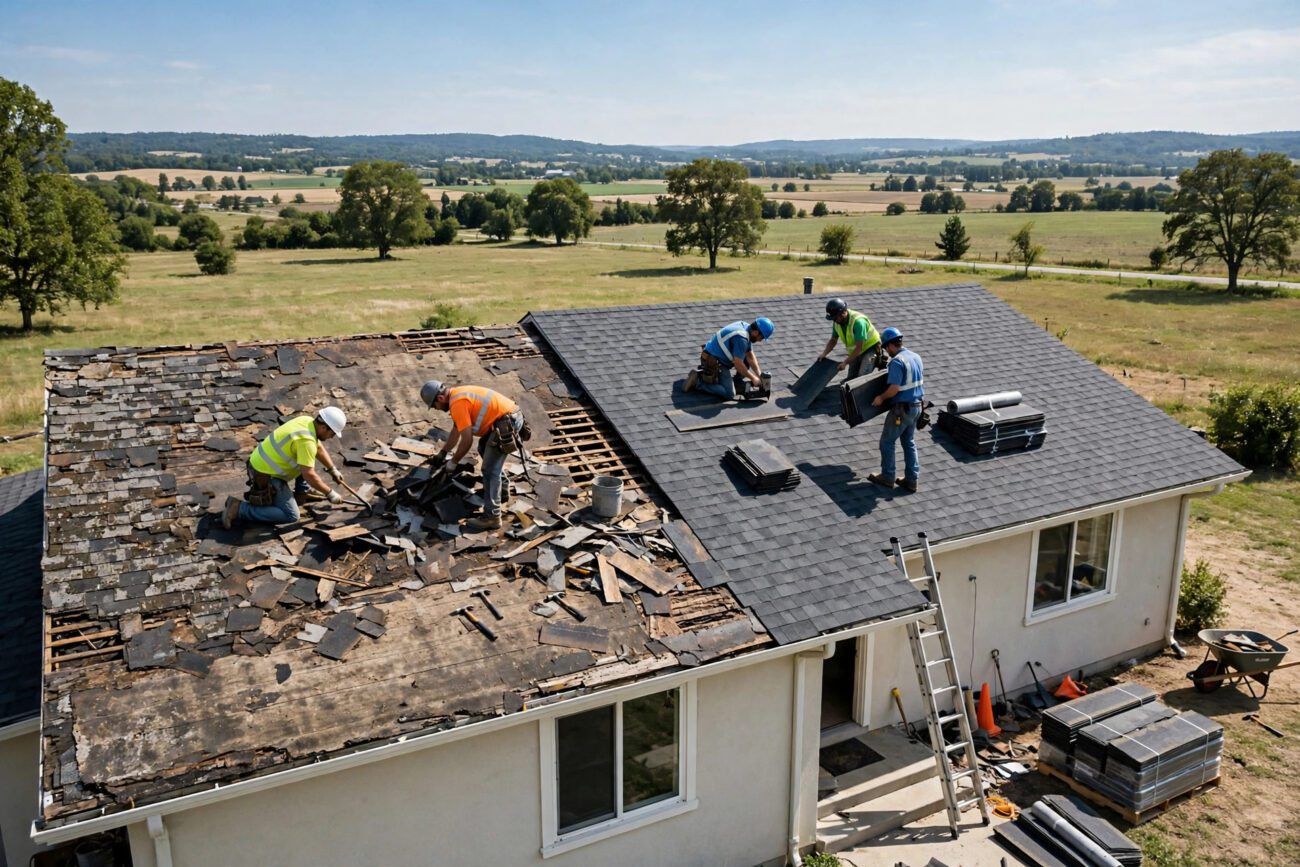
Your roof is destroyed in a storm. It will cost $15,000 to replace, but your insurer offers you only $9,000. Where did the other $6,000 go? The answer is usually one small phrase buried in your policy: actual cash value vs replacement cost. These two settlement methods decide how much your insurer pays when covered property is damaged or destroyed, and the difference can be thousands of dollars. In this guide, you will learn what each method means, how depreciation is calculated, which one fits your home, car, and belongings, and how to check which method your own policy uses before you ever need to file a claim.
What Is Actual Cash Value (ACV)?
Actual cash value is what your property was worth at the moment of the loss, after accounting for age, wear, and obsolescence. Insurers usually calculate it with a simple formula: replacement cost minus depreciation equals actual cash value.
Here is a concrete example. You bought a laptop for $1,200 three years ago. It would cost $1,000 to buy an equivalent laptop today. But after three years of use, the insurer’s depreciation schedule says the laptop has lost 60 percent of its value. The actual cash value is therefore about $400, and after your deductible, your payout could be even less. That gap between the price of a new laptop and your check is the core trade-off of ACV coverage: lower premiums in exchange for a payout that shrinks as your property ages.
ACV applies to the property itself, not to the land it sits on and not to your liability. It is the older, traditional way of settling property claims, and it still shows up in many places: older homes insured under HO-8 modified policies, personal belongings under basic homeowners policies, and almost all auto insurance, where cars lose value the moment they leave the lot.
The National Association of Insurance Commissioners describes actual cash value the same way: the value of property at the time of loss, commonly calculated as replacement cost minus depreciation. Some states add their own rules, for example, California and Washington limit or prohibit depreciating labor costs in ACV calculations.
What Is Replacement Cost Value (RCV)?
Replacement cost value is the amount it would cost to repair or replace damaged property with materials of similar kind and quality at today’s prices, with no deduction for depreciation. If a 20-year-old roof is destroyed by a covered storm, a replacement cost policy pays for a brand-new roof of the same material at current prices, minus your deductible.
Replacement cost is not the same as market value. Market value is what your home would sell for, and it includes the land, the neighborhood, and local demand. Replacement cost covers only the structure: materials, labor, fixtures, and systems needed to rebuild in the same place. It is also not what you originally paid, a home bought for $200,000 decades ago might cost $400,000 to rebuild today.
One detail catches many policyholders by surprise: replacement cost coverage often pays in two steps. First, the insurer pays the actual cash value. Then, after you actually repair or replace the property and submit receipts, it releases the remaining amount, known as recoverable depreciation. On a $15,000 roof where the ACV was $9,000, you receive $9,000 upfront (minus your deductible), pay out of pocket for the work, and then claim the remaining $6,000. If you do not repair or replace the item, you generally keep only the ACV payment.
Most standard homeowners policies in the United States cover the dwelling structure on a replacement cost basis but default to actual cash value for personal property like furniture, electronics, and clothing, unless you add a replacement cost endorsement for your belongings. That split is one of the most common sources of confusion at claim time, and it is worth checking on your own policy today.
Actual Cash Value vs. Replacement Cost: Side by Side
| Feature | Actual Cash Value (ACV) | Replacement Cost Value (RCV) |
|---|---|---|
| What it pays | Replacement cost minus depreciation, what the item was worth at the time of loss | Full cost to repair or replace with similar kind and quality at today’s prices |
| Depreciation deducted? | Yes | No |
| Premium | Lower | Higher |
| Out-of-pocket gap at claim time | Deductible plus all depreciation | Deductible only, for covered losses |
| Payment timing | Single payment | Often two steps: ACV first, then recoverable depreciation after repair |
| Best for | Older properties, secondary structures, or when lowest premium is the priority | Most homeowners, especially with older roofs or valuable contents |
| Typical use | Personal belongings by default; dwelling on HO-8 policies; auto insurance | Dwelling structure on standard HO-3 policies; belongings with an endorsement |
The table makes the trade-off plain: ACV costs less every month but can leave you thousands of dollars short when disaster strikes, while RCV costs more but closes the gap. For a 10-year-old roof costing $15,000 to replace, the difference between the two payouts can easily be $6,000, many years’ worth of premium savings wiped out in a single claim.
How Depreciation Is Calculated
Depreciation is the reduction in value of an item over time, based on its expected useful life and current condition. Insurers do not guess at it, adjusters use standardized depreciation tables and estimating software that assign a useful life to each type of property and apply a percentage per year.
A typical roof, for example, might depreciate at around 4 percent per year. A 10-year-old roof that costs $15,000 to replace has therefore lost about 40 percent of its value, leaving an actual cash value of roughly $9,000. A laptop with a five-year useful life loses value much faster than a brick wall with a 50-year life, which is why electronics produce such disappointing ACV payouts.
Several factors shape the depreciation number:
- Age: Older items are worth less, and the schedule is usually steepest in the first few years.
- Condition and maintenance: A well-maintained roof or appliance may depreciate more slowly than a neglected one, though adjusters have limited room to adjust the tables.
- Obsolescence: Technology that has been replaced by newer models, old televisions, outdated wiring, can lose value faster than age alone would suggest.
- Useful life tables: Each category of property has a standard lifespan in the insurer’s software, from a few years for electronics to decades for structural components.
If you disagree with an adjuster’s depreciation figure, you can push back: ask for the depreciation schedule in writing, provide receipts or photos showing the item was in better-than-average condition, and request a re-inspection. In some states, courts apply the “broad evidence rule,” which lets an adjuster or court consider anything that logically affects value, remaining useful life, condition, and local market conditions, rather than sticking rigidly to the formula.
ACV vs. RCV for Homeowners Insurance
For homeowners, the ACV-versus-RCV question usually breaks into three separate parts, the dwelling, the roof, and your personal belongings, and each can have a different answer on the same policy.
The dwelling: Most standard HO-3 homeowners policies insure the house itself at replacement cost, which is the right choice for most people. Insuring a home at ACV is generally not recommended, because a total loss would leave you unable to rebuild. The exception is an older or historic home that cannot be rebuilt to modern codes, where an HO-8 modified policy at ACV may be the only affordable option.
The roof: This is where the difference bites hardest. Many insurers now apply age-based roof settlement schedules: roofs under a certain age (often 10 to 15 years) settle at replacement cost, while older roofs settle at actual cash value automatically, regardless of how the rest of the policy pays. If your roof is aging, check the roof schedule in your policy, it may already be ACV even though your dwelling is RCV. Some insurers also offer a separate roof endorsement to keep RCV on older roofs for an added premium.
Personal belongings: Contents are the most common place homeowners discover they have ACV coverage. Standard policies often default belongings to actual cash value, and the fix is a replacement cost contents endorsement, which typically costs a modest amount per year. If your home holds a lot of electronics, furniture, and clothing, that endorsement usually pays for itself the first time you file a contents claim.
Surveys have found that around half of homeowners who file a claim discover their payout does not fully cover repairs once the deductible is factored in. Knowing your settlement method before a loss, not after, is the simplest way to avoid joining them.
ACV vs. RCV for Auto and Renters Insurance

Auto insurance is almost always settled at actual cash value. Cars depreciate fast, a new car can lose 20 percent or more of its value in the first year, so when your car is totaled, the insurer pays what the car was worth just before the accident, not what you paid for it or what a new one costs. That is why gap insurance exists: if you owe more on your auto loan than the car’s ACV, gap coverage pays the difference. A few insurers sell new-car replacement endorsements that pay for a brand-new equivalent vehicle if your car is totaled within its first year or two, but those are the exception, not the rule.
Renters insurance follows the homeowners pattern: the structure is your landlord’s problem, but your belongings are yours. Many renters policies default personal property to ACV, and a replacement cost endorsement is usually available for just a few dollars a month. If you are choosing between policies, ask the agent to quote both settlement methods so you can see the real price difference.
The same logic applies elsewhere: flood insurance through the National Flood Insurance Program generally pays the dwelling at replacement cost but contents at ACV, and many landlord policies use RCV for the building while applying ACV schedules to older roofs. The settlement method can differ by part of the property, so a single yes-or-no answer to “do I have replacement cost?” is never enough.
Which Is Better: ACV or Replacement Cost?
For most homeowners, replacement cost is the better choice for the dwelling, and usually for belongings too. The premium difference is real but modest: adding replacement cost coverage for contents often costs 10 to 15 percent more than an ACV policy, while the payout difference on a single claim can run into thousands of dollars. If a claim happens even once in a decade, RCV usually wins on total cost.
ACV can still make sense in a few situations:
- You are insuring property you could easily replace yourself, such as inexpensive furniture in a rental, where the premium savings matter more than the payout.
- The property is old or has little remaining useful life, so the depreciation gap is small anyway.
- Your budget genuinely cannot stretch to RCV premiums, and some coverage is better than none, but be honest with yourself about the out-of-pocket risk you are accepting.
One more consideration: replacement cost coverage only helps if you actually repair or replace the damaged property. If you plan to take the money and move on after a loss, the recoverable depreciation portion never gets paid, and you end up with the ACV amount anyway. Decide based on what you would really do after a fire or storm, not on what sounds best in theory.
How to Check Which Method Your Policy Uses
Do not wait for a claim to find out how your policy settles losses. Here is a quick check you can do today:
- Find your declarations page. It lists your coverages and limits, but the settlement method is usually in the policy form itself, not on the declarations page.
- Search the policy for “actual cash value” and “replacement cost.” Look for the loss settlement section, which states the method for the dwelling, other structures, and personal property separately.
- Check the roof schedule. Look for a roof settlement endorsement or an age-based schedule that may switch the roof to ACV after a certain age.
- Call your agent and ask three questions: Is my dwelling RCV? Are my belongings RCV or ACV? Is my roof RCV, and until what age? Write down the answers with the date.
- Ask for quotes both ways. If anything is ACV, ask what the RCV endorsement would cost per year. Then decide with real numbers instead of assumptions.
While you are reviewing your policy, it is also a good time to confirm your liability limits are adequate, if they are not, an insurance binder is not the answer, but extra liability protection may be. The declarations page is also where you will find whether your policy includes replacement cost at all, so keep a copy somewhere you can reach it after a disaster, such as a cloud folder or a safe deposit box.
Frequently Asked Questions
Is replacement cost better than actual cash value?
For most homeowners, yes. Replacement cost pays the full price to repair or replace damaged property at today’s prices without deducting depreciation, so your out-of-pocket cost at claim time is usually just the deductible. Actual cash value costs less in premiums but leaves you paying the depreciation gap yourself, which can be thousands of dollars on a roof or a major contents loss.
How is actual cash value calculated?
Actual cash value is generally calculated as replacement cost minus depreciation. The insurer estimates what it would cost to replace the item today, then subtracts depreciation based on the item’s age, condition, and expected useful life using standard tables. Some states add their own rules, such as limits on depreciating labor, and courts in some states apply a broad evidence rule that considers other factors affecting value.
Does replacement cost insurance pay the full amount upfront?
Usually not. Most replacement cost claims pay in two steps: the insurer first pays the actual cash value, then releases the remaining amount, the recoverable depreciation, after you actually repair or replace the property and submit receipts. If you choose not to repair or replace, you generally keep only the ACV payment.
What is an example of actual cash value vs. replacement cost?
Take a 10-year-old roof that costs $15,000 to replace. Under replacement cost coverage, the insurer pays toward the full $15,000 (minus your deductible). Under actual cash value, the adjuster subtracts roughly 40 percent depreciation, valuing the roof at about $9,000, leaving you to cover the $6,000 difference yourself, plus the deductible.
Does homeowners insurance cover my roof at replacement cost or actual cash value?
It depends on your policy and your roof’s age. Many standard policies cover the roof at replacement cost while it is relatively new, then switch to actual cash value once it passes a certain age, often 10 to 15 years. Check your policy’s roof settlement schedule or ask your agent, the roof is the most common place where RCV quietly becomes ACV.
Can I switch my policy from actual cash value to replacement cost?
In most cases, yes. Ask your insurer or agent for a replacement cost endorsement for your dwelling or personal property. It usually raises your premium by a modest amount, and the change generally applies going forward, not to losses that already happened. If your roof is old, the insurer may require an inspection or may decline RCV for the roof specifically.
Conclusion
Actual cash value vs. replacement cost is not a minor policy detail, it decides whether your insurance check covers the repair bill or leaves you thousands of dollars short. Replacement cost pays to rebuild or replace at today’s prices with no depreciation deducted, while actual cash value pays only what the damaged property was worth at the time of loss. For most homeowners, replacement cost on the dwelling and belongings is worth the higher premium, but the right answer depends on your property, your budget, and what you would do after a loss. Pull out your policy today, check the settlement method for your dwelling, roof, and belongings separately, and ask your agent for the RCV quote if anything is still ACV.
This article is for general educational purposes only and does not constitute insurance or financial advice. Coverage and settlement methods vary by insurer, policy form, and state law. Consult a licensed insurance agent for guidance specific to your situation.
