
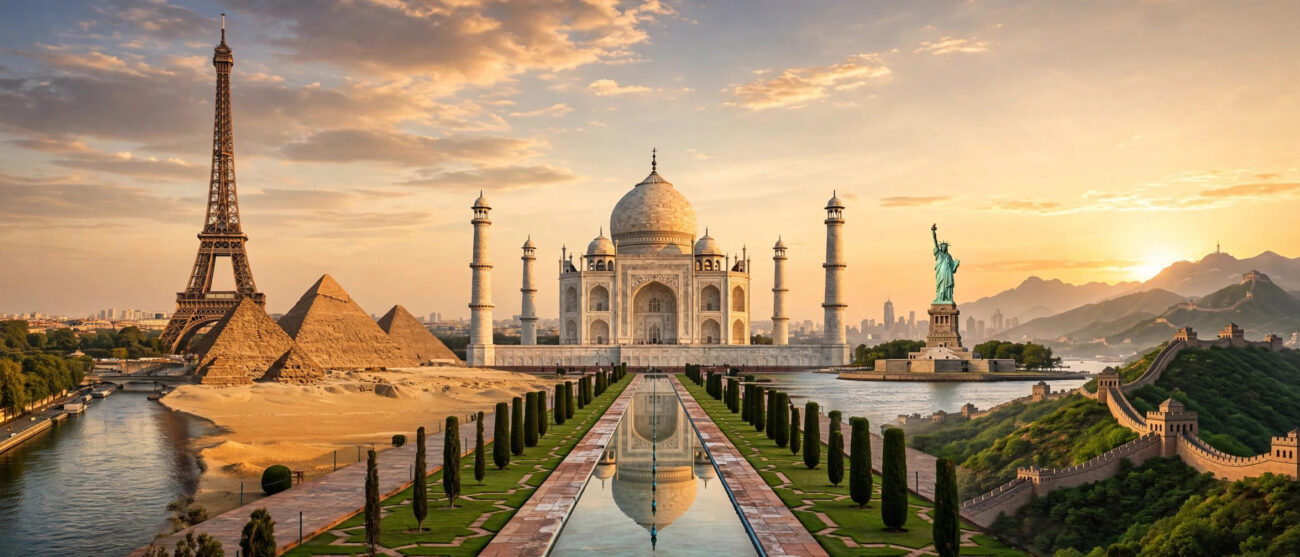
Some places stop you in your tracks the moment you see them. The famous landmarks of the world do exactly that. You have seen them on postcards, in films, and on travel wish lists for years, yet standing in front of the Eiffel Tower, the Pyramids of Giza, or the Taj Mahal still feels different from seeing a photo. This guide brings the most famous landmarks together in one place, grouped by region and by type, so you can plan a trip, build a bucket list, or simply learn what makes each place matter.
What Are Famous Landmarks?
A landmark is a place or structure so recognizable that it defines its location. You cannot picture Paris without the Eiffel Tower, or Egypt without the Pyramids. Famous landmarks are the ones the whole world recognizes, often at a glance, even without a caption.
Landmarks fall into four main types. Natural landmarks were shaped by nature alone, such as the Grand Canyon, Victoria Falls, and Mount Everest. Historical landmarks are proof that past civilizations existed and built great things, such as the Colosseum, Angkor Wat, and Machu Picchu. Architectural landmarks show what engineering and ambition can do, such as the Eiffel Tower, the Burj Khalifa, and the Sydney Opera House. Cultural landmarks carry meaning beyond their shape, such as the Statue of Liberty, the Taj Mahal, and Christ the Redeemer.
Many famous landmarks also hold UNESCO World Heritage status. There are 1,199 UNESCO World Heritage Sites in the world, and a place earns that label only when the world agrees it is too important to lose. UNESCO status is a useful clue for travelers. If a site is on the list, it usually has real historical, cultural, or natural value, and it is usually protected and managed for visitors.
The Most Famous Landmarks in the World
Every list of the most famous landmarks sparks debate, but a small group appears on almost every shortlist. These ten are recognized across the world, draw millions of visitors, and carry deep cultural meaning.
The Eiffel Tower, Paris. Built for the 1889 World’s Fair and meant to be temporary, it now draws about 7 million visitors a year. After dark it sparkles for five minutes at the start of every hour.
The Pyramids of Giza, Egypt. The Great Pyramid is the only one of the Seven Wonders of the Ancient World still standing. The pyramids have stood in the desert for more than 4,500 years.
The Taj Mahal, India. Built between 1632 and 1653 by the Mughal emperor Shah Jahan as a tomb for his wife, it draws about 8 million visitors a year. Its white marble turns pink at dawn and gold at sunset.
The Great Wall of China. The longest wall in the world, stretching over 21,000 kilometres in its various sections, it draws more than 10 million visitors a year. It is not one continuous wall, but a series of fortifications built over 2,000 years.
The Statue of Liberty, New York. A gift from France to the United States, Lady Liberty has stood in New York Harbor since 1886. In one global survey, almost 99 percent of people could identify it correctly.
The Colosseum, Rome. Completed around 80 AD, it held up to 80,000 spectators. It is the top attraction in Italy and draws about 12 million visitors a year.
Machu Picchu, Peru. Hidden high in the Andes and forgotten for more than 300 years, it was brought back to world attention in 1911. About 1.5 million people visit each year.
Christ the Redeemer, Rio de Janeiro. The 38 metre statue stands on Corcovado mountain, looking out over Rio. It is one of the New Seven Wonders of the World.
The Grand Canyon, Arizona. Carved by the Colorado River over five to six million years, it is 277 miles long and up to 18 miles wide. About 6 million people visit each year.
The Burj Khalifa, Dubai. At 828 metres, it is the tallest building in the world. It opened in 2010, and its observation deck on the 154th floor sits more than 550 metres above the ground.
Famous Landmarks in Europe
Europe holds more famous landmarks per square mile than any other continent, and most are easy to reach by train or on foot. In London, Big Ben leads the list, with the Tower of London, Westminster Abbey, and the London Eye all close by. In Paris, the Eiffel Tower is joined by the Louvre, Notre-Dame Cathedral, and Sacre-Coeur on Montmartre hill. For a full Paris plan, see our guide to the top tourist attractions in Paris. In Rome, the Colosseum, the Vatican, and St. Peter’s Basilica sit close together, and the Leaning Tower of Pisa and Pompeii are easy day trips. In Barcelona, the Sagrada Familia has been under construction since 1882, and in Athens the Parthenon has crowned the Acropolis since the 5th century BC.
Famous Landmarks in Asia and the Middle East
Asia holds some of the oldest and largest landmarks on Earth, and many need more planning than a European city break. In India, the Taj Mahal is the star, and Agra Fort nearby is worth half a day. In Cambodia, Angkor Wat is the largest religious monument in the world and needs at least one full day, ideally two. In China, the Great Wall is best visited at Mutianyu or Jinshanling, which are less crowded than Badaling. In Japan, Mount Fuji is the most famous natural landmark, and the temples of Kyoto draw millions of visitors each year. In the Middle East, the Burj Khalifa is the tallest building in the world, and Petra in Jordan, carved into rose-red rock around 300 BC, is one of the most photographed views on Earth.
Famous Landmarks in the Americas
The Americas mix ancient ruins, modern cities, and huge natural wonders, so pick one region per trip. In New York, the Statue of Liberty and the Empire State Building lead the list, and Times Square draws about 42 million visitors a year. In Washington, D.C., the White House, the Lincoln Memorial, and the Washington Monument sit along the National Mall. In the west, Mount Rushmore, the Golden Gate Bridge, and the Hollywood Sign are all icons. In Mexico, Chichen Itza was a major Maya city, and its pyramid was built so precisely that on the equinoxes, shadows form a serpent sliding down the steps. In Peru, Machu Picchu is reached by train from Cusco, and both sites need timed tickets. In Brazil, Christ the Redeemer is the icon, and the best photos come from viewpoints like Mirante Dona Marta.
Famous Natural Landmarks
Not every famous landmark was built. Some of the most visited places on Earth were shaped by water, wind, and time alone, and they need a different kind of planning.
The Grand Canyon. The South Rim is the easiest side to visit, with viewpoints, shuttle buses, and short walks. Yaki Point is a good spot for sunset, and it is less crowded than the main viewpoints. Spring and autumn offer cooler weather and thinner crowds.
Victoria Falls. On the border of Zambia and Zimbabwe, Victoria Falls is the largest curtain of falling water on Earth. Its local name, Mosi-oa-Tunya, means “the Smoke That Thunders,” and the spray can rise 400 metres into the air. The best flow is usually from February to May, after the rainy season.
Mount Everest. At 8,849 metres, Everest is the highest point on Earth. Only around 500 to 600 people reach the summit each year. Most travelers see it from a base camp trek or a flight over the Himalayas.
The Great Barrier Reef. Off the coast of Queensland, Australia, the Great Barrier Reef is the largest coral reef system in the world, about 2,300 kilometres long. Snorkeling trips run from Cairns and Port Douglas, and the dry season from June to October usually brings the clearest water.
Niagara Falls. On the border of the United States and Canada, Niagara Falls is free to view from the park on either side, while boat rides and viewpoints cost extra. The falls are at their best in summer, when the flow is strong and the boat tours run every day.
Famous Landmarks Compared
It helps to compare landmarks by type before you plan. Some are free to see from the street, others need timed tickets booked weeks ahead, and a few are closed to most visitors altogether.
| Landmark | Location | Type | Entry | Best Time to Visit |
|---|---|---|---|---|
| Eiffel Tower | Paris, France | Architectural | Paid, timed ticket | Early morning or late evening |
| Pyramids of Giza | Giza, Egypt | Historical | Paid plateau ticket | Opening time, cooler months |
| Taj Mahal | Agra, India | Cultural | Paid, higher for foreign visitors | Sunrise, October to March |
| Great Wall of China | Northern China | Historical | Paid, per section | Spring or autumn |
| Statue of Liberty | New York, USA | Cultural | Ferry ticket, crown needs booking | First morning ferry |
| Colosseum | Rome, Italy | Historical | Paid, timed entry | Early morning, spring or autumn |
| Machu Picchu | Cusco, Peru | Historical | Timed ticket plus circuit | Dry season, May to September |
| Grand Canyon | Arizona, USA | Natural | Park fee per vehicle | Spring or autumn |
| Burj Khalifa | Dubai, UAE | Architectural | Paid observation deck | Sunset, November to March |
| Christ the Redeemer | Rio de Janeiro, Brazil | Cultural | Paid entry and transport | Morning, before clouds build |
Use the table as a starting point, not as a price list. Entry rules and prices change often, so always check the official site before you travel, and check your government’s travel advice for any country affected by conflict or unrest.
How to Visit Famous Landmarks
Book timed tickets early. The Eiffel Tower, the Colosseum, Machu Picchu, and the Louvre all use timed entry, and summer slots can sell out weeks ahead. Book on the official site, not through a street seller, and keep your confirmation and photo ID with you. For the Statue of Liberty, crown access needs booking months ahead.
Go early or late. The first morning slot and the last evening slot are usually the quietest. Early light is also better for photos, and the air is cooler in hot places like Egypt, India, and Peru. At the Eiffel Tower, the hourly sparkle after dark is free to watch from the Trocadero or the Champ de Mars.
Budget realistically. Some landmarks, like Big Ben and the Hollywood Sign, are free to view from outside. Others charge a typical range of about 15 to 40 euros or dollars per adult for entry or an observation deck.
Pick a base and go slow. Trying to see five landmarks in one day rarely works. Pick one or two per day, leave time for the area around them, and build in a rest. In Rome, the Colosseum and the Roman Forum belong together in one morning, while the Vatican deserves a separate day.
FAQs About Famous Landmarks
What is the most famous landmark in the world?
The Eiffel Tower is often named the most famous landmark in the world, thanks to its design, its history, and the fact that about 7 million people visit it each year. The Statue of Liberty is a close rival, and the Great Wall of China is the most visited, with more than 10 million visitors a year.
What is the most visited landmark in the world?
The Great Wall of China is usually named the most visited landmark, with more than 10 million visitors a year. Times Square in New York draws about 42 million people a year, although it is a district rather than a single monument.
What are the 7 most famous landmarks?
A common top seven is the Eiffel Tower, the Pyramids of Giza, the Taj Mahal, the Great Wall of China, the Statue of Liberty, the Colosseum, and Machu Picchu. Other lists add Christ the Redeemer, the Grand Canyon, and the Burj Khalifa.
What is a famous landmark?
A famous landmark is a natural or man-made place that is widely recognized and defines its location. It can be a building, a monument, a mountain, a waterfall, or a whole historic site. Landmarks become famous because of their history, their size, their beauty, or their cultural meaning.
How many UNESCO World Heritage Sites are there?
There are 1,199 UNESCO World Heritage Sites in the world. A site earns the label when it has outstanding universal value, whether cultural, historical, or natural. Many famous landmarks, including the Colosseum, the Pyramids of Giza, and Machu Picchu, are on the list.
What is the oldest famous landmark still standing?
The Great Pyramid of Giza is the oldest famous landmark still standing. It was built around 2560 BC, more than 4,500 years ago, and it is the only one of the Seven Wonders of the Ancient World that still exists. Stonehenge in England is even older in parts, dating to around 3000 BC.
Do you need tickets in advance for famous landmarks?
For the most popular landmarks, yes. The Eiffel Tower, the Colosseum, Machu Picchu, the Louvre, and the Statue of Liberty crown all use timed tickets, and slots can sell out weeks or even months ahead in summer. Free viewpoints, such as Big Ben from the street, need no ticket at all.
Conclusion
The most famous landmarks in the world are famous for a reason. They mark the best of what people have built and what nature has shaped, and they repay a little planning with memories that last for years. Start with the top ten, pick a region to explore in depth, book your tickets early, and give each place the time it deserves. The photo matters less than the visit itself, and the best landmark trips are the ones where you slow down and enjoy being there.
Related Reading: Top Tourist Attractions in Paris | What Is Picuki and How It Lets You Browse Instagram Anonymously
For official background on protected sites, see the UNESCO World Heritage List and the Seven Wonders of the World on Wikipedia.
