
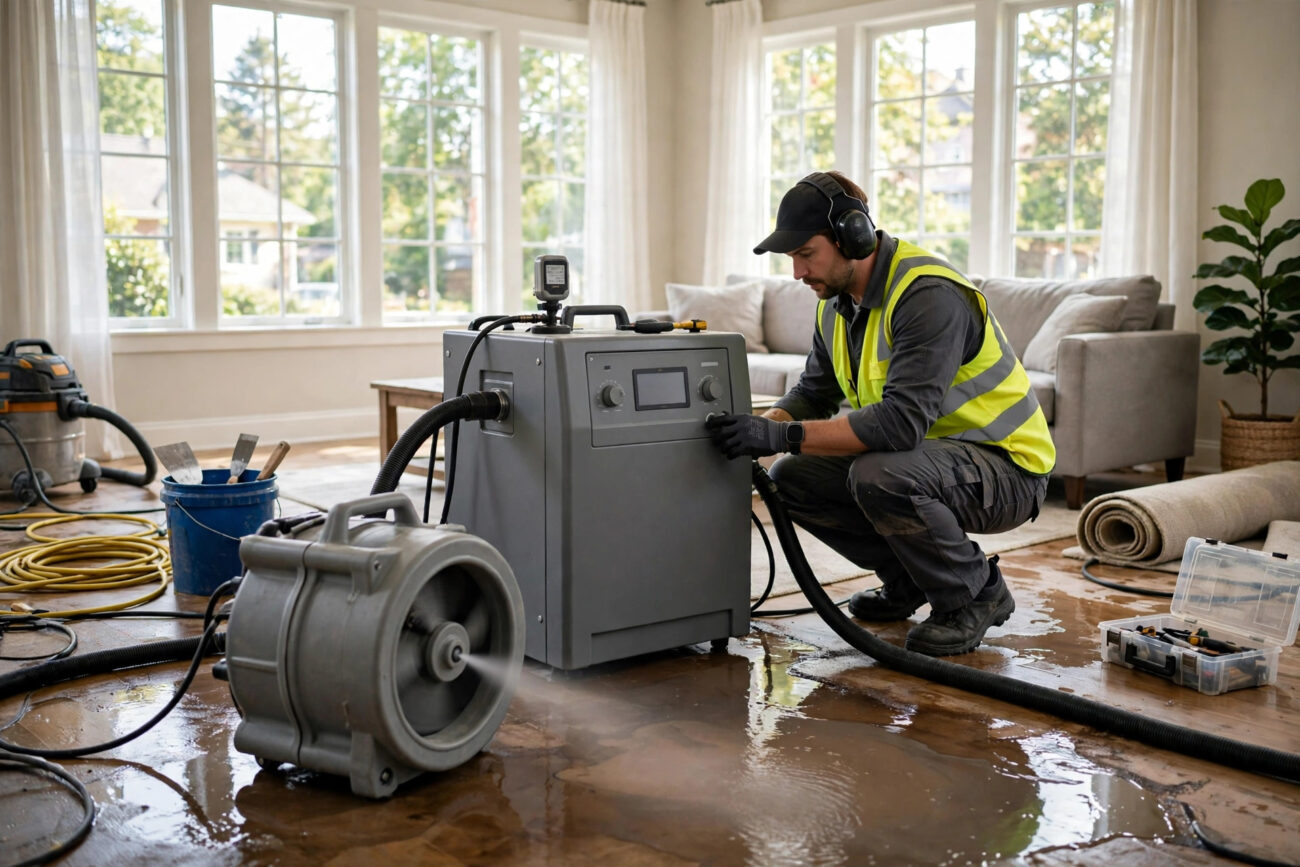
A burst pipe at 2 a.m., a washing machine hose that finally gives up, or a storm that pushes water under your back door: however it starts, water damage is one of the most stressful and expensive problems a homeowner can face. The first question is always the same: how much does water damage restoration cost? The short answer is that most professional jobs in the United States cost between $1,385 and $6,381, with a national average of about $3,870 in 2026. This guide explains how that number is built, what drives it up or down, when insurance helps, and how to tell a fair quote from an inflated one.
All prices below are typical 2026 US ranges drawn from published cost guides such as Angi and HomeAdvisor, and they are planning benchmarks, not quotes for your home. Your final bill depends on the type of water, the size of the wet area, how long the water sat, and what has to be torn out and rebuilt. The ranges here will help you judge whether an estimate is reasonable before you sign anything.
What Is Water Damage Restoration?
Water damage restoration is the professional process of removing water from a home, drying the structure completely, cleaning and sanitizing what can be saved, and repairing or replacing what cannot. It is different from a simple cleanup. A mop and a fan handle a spill. Restoration deals with water that has soaked into drywall, subfloors, insulation, and framing, where it can cause mold, rot, and structural damage if it is left damp.
Restoration has two distinct phases, and they are usually priced separately. Mitigation is the emergency phase: water extraction, drying with industrial fans and dehumidifiers, moisture monitoring, and antimicrobial treatment. Rebuild is the repair phase: replacing drywall, flooring, baseboards, and anything else that was removed or ruined. Mitigation typically runs $3 to $7.50 per square foot, while rebuild work often adds $20 to $37 per square foot for basic scopes. Knowing which phase a quote covers is the first step to comparing estimates fairly.
Restoration companies also classify the water itself, and that classification drives much of the price. The industry standard, ANSI/IICRC S500, sorts water into three categories based on where it came from, not what it looks like. Category 1 is clean water from a supply line, a faucet, or rainwater that has not touched anything dirty. Category 2 is gray water from a dishwasher, washing machine, or toilet overflow without solids. Category 3 is black water: sewage backup, river flooding, or any water that has sat long enough to grow biological contamination. Clean water does not stay clean, and water left standing for 48 hours or more usually degrades into a higher category, which means more material gets thrown out and the bill goes up.
How Water Damage Restoration Works
A professional job follows the same sequence almost every time, and understanding it helps you see what you are paying for.
1. Inspection and assessment. A technician walks the affected area with moisture meters and sometimes infrared cameras to find water you cannot see, including water inside walls and under floors. This step usually takes under an hour and often costs nothing when you hire the company for the job. Some companies charge a separate inspection or emergency callout fee of $75 to $200, so ask before you book.
2. Water extraction. Standing water is pumped or vacuumed out with truck-mounted extractors. This is the fastest part of the job, but it is also the most urgent, because every hour water sits, it soaks deeper and the damage spreads.
3. Drying and dehumidification. Industrial air movers and dehumidifiers run for three to five days on a typical job. Technicians return daily to check moisture readings and move equipment until the structure is dry to industry standards. Rushing this step is the most common cause of mold appearing weeks later.
4. Cleaning and sanitizing. Affected surfaces get antimicrobial treatment. With gray or black water, porous materials such as carpet padding, insulation, and drywall below the waterline are usually removed and discarded rather than cleaned.
5. Repair and rebuild. Once everything is dry, the crew replaces drywall, flooring, trim, and paint, and restores the room to its pre-loss condition. This phase is often handled by a separate crew or a different contractor, and it is where the total cost can double if the damage was extensive.
Water Damage Restoration Cost by Water Category
The type of water is the single biggest cost driver per square foot. The table below shows typical 2026 mitigation rates, covering extraction, drying, and sanitizing, before rebuild work.
| Water category | Common sources | Typical cost per sq ft |
|---|---|---|
| Category 1, clean water | Burst supply pipe, overflowing sink, rainwater | $3 to $4 |
| Category 2, gray water | Dishwasher or washing machine overflow, sump pump failure | $4 to $6.50 |
| Category 3, black water | Sewage backup, river or storm flooding, standing water over 48 hours | $7 to $7.50 |
For a 500-square-foot affected area, that works out to roughly $1,500 to $2,000 for clean water, $2,000 to $3,250 for gray water, and $3,500 to $3,750 for black water, for mitigation alone. Rebuild costs come on top, and they are often as large as the mitigation bill itself.
Water Damage Restoration Cost by Room
Where the water lands matters almost as much as how much there is. Kitchens and bathrooms cost more per square foot than a spare bedroom because they have cabinets, tile, and plumbing fixtures that complicate drying and removal. Basements are expensive for a different reason: water pools at the lowest point, concrete and framing stay damp longer, and finished basements add drywall and carpet to the rebuild.
Typical 2026 ranges for a single-room job, mitigation plus basic repairs, look like this:
- Bathroom: $1,000 to $3,500. Small area, but tile, vanity, and fixtures add rebuild cost.
- Kitchen: $2,000 to $6,000. Cabinets often must be removed to dry the wall behind them, and appliance connections complicate the work.
- Bedroom or living room: $1,500 to $4,500. Cost depends mostly on flooring type, since carpet and hardwood dry very differently.
- Basement: $2,500 to $8,000 or more. Finished basements sit at the high end, and sewage backup in a basement is one of the most expensive common scenarios.
- Whole house or multiple rooms: $5,000 to $16,000 or more, with severe flooding and full rebuilds going higher.
Flooring is a major swing factor. Carpet is usually the cheapest to deal with because the padding is discarded and the carpet itself is often replaced, while solid hardwood can sometimes be saved with slow, careful drying, but it can also warp beyond repair if it stays wet for days. Tile is durable but the subfloor underneath can still be ruined. Your contractor should explain which materials in your home can be dried and which must go, because that decision moves the bill by thousands of dollars.
What Affects Water Damage Restoration Cost?
How long the water sat. Water found and dried within hours is a small job. Water discovered after a weekend away, or a slow leak that ran for weeks inside a wall, is a large one. Time turns clean water dirty, grows mold, and forces more demolition.
Size of the affected area. Restoration is priced largely per square foot, so a leak contained to one bathroom costs far less than water that spread across an entire floor.
Materials involved. Hardwood, plaster, and custom cabinetry take longer to dry and cost more to replace than vinyl flooring and standard drywall. Older homes with plaster walls and hardwood floors usually land at the high end of every range.
Location and access. Water in a finished basement, behind built-in cabinetry, or under a slab is harder and more expensive to reach than water on an open ground-floor room. Emergency or after-hours calls also carry higher rates, often $100 to $200 more for the initial visit.
Mold. If mold has already started, remediation is a separate line item, typically $500 to $6,000 depending on the area, and it must be handled before rebuild work begins. The EPA mold cleanup guidance explains when a small area can be handled by a homeowner and when a professional is needed.
Your region. Labor rates vary widely by city. The same job costs noticeably more in a high-cost metro than in a small town, and storm-hit areas see prices spike when every contractor in the region is booked solid.
Does Homeowners Insurance Cover Water Damage Restoration?
Usually, yes, but only for sudden and accidental damage. A burst pipe, a failed appliance hose, or a roof leak caused by a storm is typically covered. A slow leak you knew about for months, damage from a lack of maintenance, or groundwater seeping through a foundation is usually not covered. Flood damage from rising water is almost never covered by a standard homeowners policy, and it needs separate flood insurance. If you are unsure what your policy covers, our guide to what flood insurance covers explains the difference, and it is worth reading your declarations page before you file a claim. Our article on how to read an insurance declarations page shows where to find your coverage limits and deductible.
If the damage is covered, file the claim as soon as possible and document everything: photos and video of the damage, a list of ruined items, and every receipt. Do not wait for an adjuster before stopping the water or starting emergency drying, since your policy requires you to prevent further damage. Most insurers pay the mitigation bill first and the rebuild bill after the work is approved, and you will pay your deductible out of pocket either way. If your home has a history of water problems, a sump pump installation can reduce the risk of the next basement flood.
DIY vs Professional Water Damage Restoration: Pros and Cons
Small, clean-water spills are a reasonable DIY job. If you caught a leak fast, the water is clean, the area is small, and you can dry it fully within 24 to 48 hours with fans and a dehumidifier, you can often handle it yourself for under $200 in equipment rental. The risk is hidden moisture: water inside a wall cavity or under a floor can keep feeding mold long after the surface feels dry.
Professional restoration is the safer choice when the water is gray or black, when more than one room is wet, when water has been sitting for more than a day, or when you smell mildew or see staining on ceilings or baseboards. Professionals bring moisture meters that prove a wall is dry, industrial equipment that dries in days instead of weeks, and documentation your insurer wants to see. The cost is real, usually $1,385 to $6,381 for a typical job, but a botched DIY dry-out that leads to mold can cost far more to fix later.
Water Damage Restoration FAQs
How long does water damage restoration take?
Mitigation usually takes three to five days of drying, plus a day or two for extraction and cleaning. A full job including rebuild typically takes one to three weeks, and large or multi-room jobs can take a month or more, mostly because materials must be fully dry before new drywall or flooring goes in.
Can I stay in my home during water damage restoration?
For small, clean-water jobs, usually yes. For black water, sewage backup, or large-scale drying with heavy equipment running around the clock, most families stay elsewhere for a few days. Your insurer may cover temporary living costs if your policy includes loss-of-use coverage, so ask your adjuster before you book a hotel.
Does water damage always cause mold?
Not always, but mold can start growing on damp surfaces within 24 to 48 hours, which is why fast drying matters so much. Water found and dried within a day rarely leads to mold. Water left damp for several days almost always does, and then mold remediation becomes a separate cost on top of the restoration bill.
How much does water damage restoration cost per square foot?
Typically $3 to $7.50 per square foot for mitigation, depending on the water category: about $3 to $4 for clean water, $4 to $6.50 for gray water, and $7 to $7.50 for black water. Rebuild work is priced separately, often $20 to $37 per square foot for basic scopes.
Is water damage restoration covered by flood insurance?
Flood insurance covers damage from rising water, such as a river overflowing or a storm surge, up to your policy limits. It does not cover a burst pipe or an appliance leak, which fall under a standard homeowners policy instead. Many homeowners need both types of coverage to be fully protected.
How do I choose a water damage restoration company?
Look for IICRC certification, 24/7 emergency response, a written estimate that separates mitigation from rebuild, and experience working directly with insurers. Get at least two quotes for any job over $2,000, and be wary of any company that pressures you to sign before you have read the estimate.
Conclusion
Water damage restoration typically costs $1,385 to $6,381 in 2026, with a national average near $3,870, and the final number comes down to the water category, the size of the wet area, and how fast drying starts. Act within hours, not days: stop the water, call your insurer, and get a professional drying crew in before mold has a chance to start. A fast, well-documented response keeps the bill smaller and makes the insurance claim far easier.
