
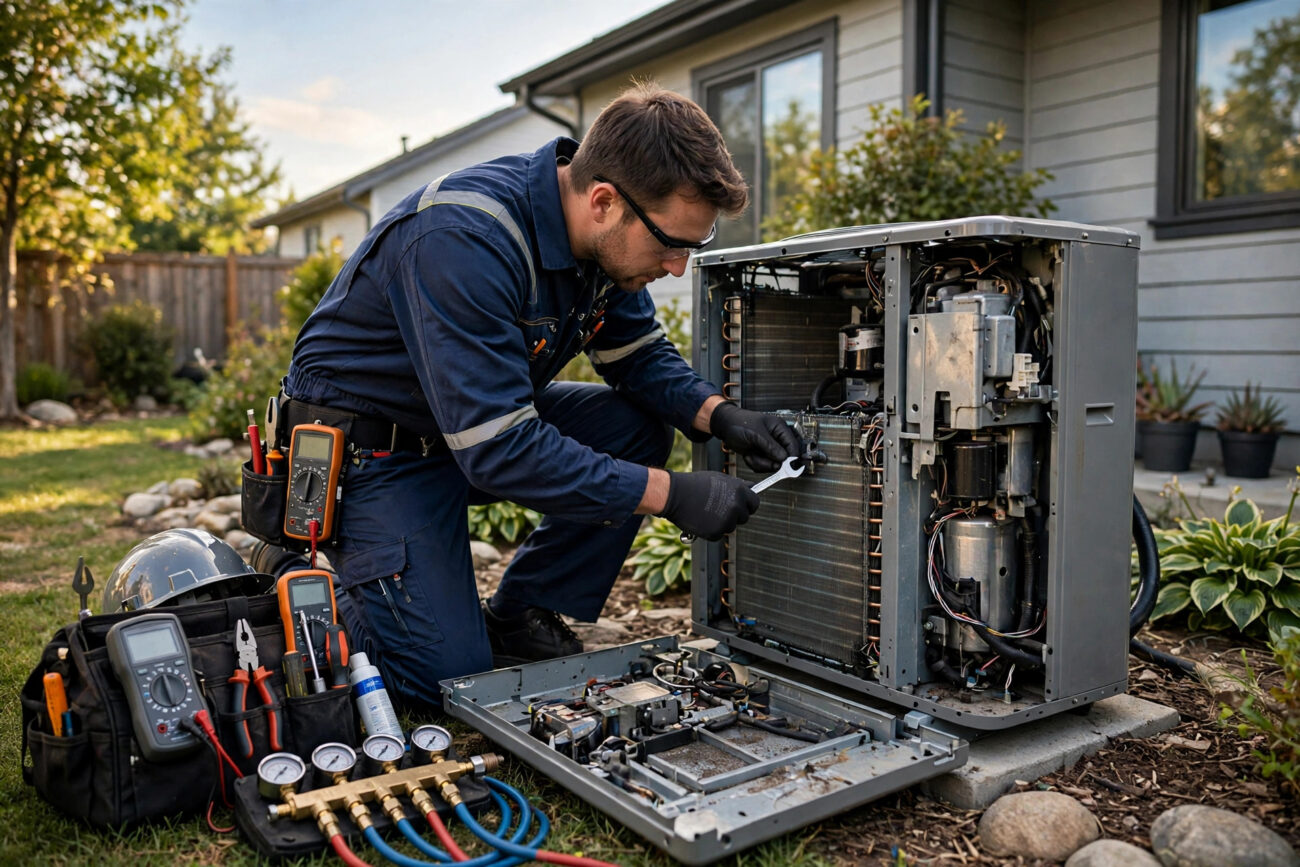
Your air conditioner stops cooling on the hottest week of the year, and the first question is always the same: how much is this going to cost? The short answer is that most AC repairs cost $150 to $650, with a national average of about $350 to $375 in 2026. This guide explains how much AC repair costs by problem and by part, when a repair is worth it and when replacement makes more sense, and how to avoid paying emergency prices for a routine fix.
All figures here are typical 2026 US ranges from Angi, This Old House, Fixr, and Thumbtack, verified at writing time. Your final bill depends on your area, your system, and the time of day you call, but the ranges below will tell you whether a quote is fair before you agree to it.
How Much Does AC Repair Cost in 2026?
Most repairs land in the $150 to $650 band. Angi’s 2026 data puts the full range at $130 to $2,000, with an average of about $350, and the typical repair most homeowners actually pay for sits in the middle of that range. A simple fix like a capacitor or a clogged drain is at the low end. A failed compressor or a leaking coil is at the high end, and can cross into the thousands.
The first charge on most bills is the diagnostic fee, usually $75 to $150 for a technician to visit, inspect the system, and find the fault. Many companies credit that fee toward the repair if you go ahead with their quote, so ask before you book. If a company charges a diagnostic fee and then refuses to credit it, that is a sign to get a second quote. A diagnostic visit should end with a written quote that names the part, the labour, and the total, not a verbal estimate you have to remember.
Labour is usually billed at $100 to $150 per hour, which is the rate the company charges you, not what the technician earns. The Bureau of Labor Statistics put the median wage for HVAC technicians at $29.33 per hour in May 2025, and the difference covers the company’s overhead, insurance, vehicle, and warranty on the work. A one-hour repair and a three-hour repair can differ by hundreds of dollars for the same part, so ask how many hours the job is expected to take.
AC Repair Cost by Part
The part that failed is the biggest driver of the bill, so here is what each common repair typically costs, parts and labour included.
| Part or problem | Typical cost | Notes |
|---|---|---|
| Capacitor | $150 to $300 | Most common fix, under an hour |
| Contactor | $150 to $250 | Electrical switch, quick job |
| Condensate drain | $125 to $400 | Clog or leak, water damage risk |
| Refrigerant recharge (R-410A) | $150 to $400 | Only a licensed tech may handle it |
| Fan or blower motor | $500 to $1,200 | Several hours of labour |
| Evaporator or condenser coil | $700 to $2,700 | Often a replacement decision |
| Compressor | $1,000 to $3,000 or more | Most expensive repair |
A capacitor is the classic cheap fix. It is a small cylinder that helps the motors start, and when it fails the unit hums but does not start, or the fan does not spin. The part itself costs little, the job takes under an hour, and the total is usually $150 to $300. A contactor is similar: an electrical switch that wears out, a quick replacement, $150 to $250.
A condensate drain problem is messier. The drain carries away the water your AC pulls from the air, and when it clogs, water backs up and can leak into your home. Clearing it costs $125 to $400, and the upper end applies when there is water damage to clean up. If you see water pooling near the indoor unit, turn the system off and call a technician, because running it will make the leak worse.
Refrigerant is a special case. A recharge of R-410A typically costs $150 to $400, but a system that needs frequent recharges has a leak, and the leak is the real problem. Only a technician with EPA Section 608 certification may legally handle refrigerant in the United States, so this is never a do-it-yourself job. A reputable technician will find and fix the leak rather than just topping the system up and leaving.
At the expensive end, a fan or blower motor costs $500 to $1,200, a coil costs $700 to $2,700, and a compressor, the heart of the system, costs $1,000 to $3,000 or more. When a quote reaches those levels, the repair-versus-replace question below becomes the one that matters.
Emergency and After-Hours Costs
Calling at night, on a weekend, or on a holiday adds $75 to $300 to the bill, on top of the repair itself. That premium is the price of a technician coming out outside normal hours, and it is usually worth it only when the failure is a real emergency: a home with an infant, an elderly person, or someone with a medical condition in extreme heat, or a leak that is actively damaging the house.
For most other failures, waiting until morning saves the premium and often gets you a better technician, because the on-call crew is whoever is available, not necessarily the most experienced. While you wait, close the blinds, run fans, and avoid using ovens or other heat sources. If the system is leaking water, turn it off at the thermostat and the breaker, and put towels or a bucket under the leak.
A routine tune-up, by contrast, costs $170 to $752, and it is the cheapest money in air conditioning. A yearly service visit catches a weak capacitor, a dirty coil, or a low refrigerant charge before they become a breakdown, and a clean, well-maintained system uses less electricity. Book it in spring, before the summer rush, when companies have open slots and sometimes offer discounts.
Repair or Replace: How to Decide
There is a simple rule technicians use. Multiply the age of the unit in years by the cost of the repair. If the result is over $5,000, replacement usually makes more sense than repair. A 12-year-old unit with a $600 repair gives 12 times 600, which is $7,200, so replace. A 5-year-old unit with a $300 repair gives $1,500, so repair. The rule is a guide, not a law, but it stops you from spending good money on a system that will fail again next summer.
A second rule is simpler: if the repair costs more than $800 to $1,000 and the unit is over ten years old, replacement is usually the better spend. A new central AC system costs $3,800 to $7,500 installed, with Thumbtack’s range at $2,063 to $8,667 depending on size and region. That is a large sum, but a new system is more efficient, comes with a fresh warranty, and stops the cycle of yearly repairs on an old unit. It also uses a modern refrigerant, which matters as older refrigerants become more expensive and harder to find.
Three other factors tip the decision. First, efficiency: a unit from 2010 uses far more electricity than a 2026 model, so the energy savings of a new system can pay back part of the cost over a few years. Second, warranty: if the failed part is still under the manufacturer’s warranty, repair is almost always right, because the part itself may be free and you only pay labour. Third, comfort: if some rooms have never cooled properly, the problem may be ductwork or sizing, not the AC unit, and a new unit alone will not fix it.
One note on costs: the federal 25C tax credit for energy-efficient home improvements ended on 31 December 2025, so do not let a salesperson quote it as still available. State and utility rebates may still exist in your area, and they are worth checking before you buy, but the federal credit is gone.
How to Avoid Overpaying
Get two quotes for any repair over $500. The quotes should name the same part and the same work, so you can compare them fairly. Be wary of a technician who finds three problems on a system that had one symptom, or who pressures you to decide on the spot. A genuine fault can wait an hour while you call another company.
Ask whether the part is under warranty before agreeing to anything, and ask for the old part back after the repair. Keep the filters clean, because a clogged filter is the most common cause of poor cooling and frozen coils, and it is a $10 fix you can do yourself. Change or clean the filter every one to three months in summer, keep the outdoor unit clear of leaves and debris, and hose the coils gently once a year. Those three habits prevent a surprising share of service calls.
Finally, check the company before you book. Look for a license, insurance, and recent reviews that mention the same kind of job. A company that advertises a $29 tune-up and then finds $2,000 of urgent work on every visit is not a bargain. A fair company gives a written quote, explains the fault in plain language, and lets you say no.
Frequently Asked Questions
How much does AC repair cost in 2026?
Most repairs cost $150 to $650, with a national average of about $350 to $375. Angi’s 2026 range is $130 to $2,000. Simple fixes like a capacitor are $150 to $300, while a compressor can cost $1,000 to $3,000 or more.
How much is a diagnostic fee?
Usually $75 to $150 for a technician to visit and find the fault. Many companies credit the fee toward the repair if you go ahead with their quote, so ask before you book.
When should I repair vs replace?
Use the age-times-cost rule: if the unit’s age in years multiplied by the repair cost is over $5,000, replace it. Also replace when a repair costs more than $800 to $1,000 on a unit over ten years old. A new central AC system typically costs $3,800 to $7,500 installed.
What is the most expensive AC repair?
The compressor, at $1,000 to $3,000 or more. A coil replacement is next, at $700 to $2,700. When a quote reaches those levels on an older unit, replacement is usually the better spend.
Can I recharge refrigerant myself?
No. Handling refrigerant legally requires EPA Section 608 certification in the United States. A system that needs frequent recharges has a leak, and a licensed technician should find and fix the leak rather than just topping it up.
Why does emergency AC repair cost more?
After-hours, weekend, and holiday calls add $75 to $300 to the bill for the technician’s out-of-hours visit. Unless there is a medical need or active water damage, waiting until morning usually saves the premium.
Conclusion
Most AC repairs cost $150 to $650, with a $75 to $150 diagnostic fee and an average bill of about $350. The part that failed sets the price, from a $150 capacitor to a $3,000 compressor, and the age-times-cost rule tells you when to stop repairing and start replacing. Get two quotes on big jobs, keep the filters clean, book a yearly tune-up in spring, and never let a salesperson quote the expired federal 25C credit. A little knowledge before the technician arrives is the cheapest part of any repair.
For the full 2026 price guide, see Angi’s HVAC repair cost guide and Thumbtack’s AC service cost page.
