
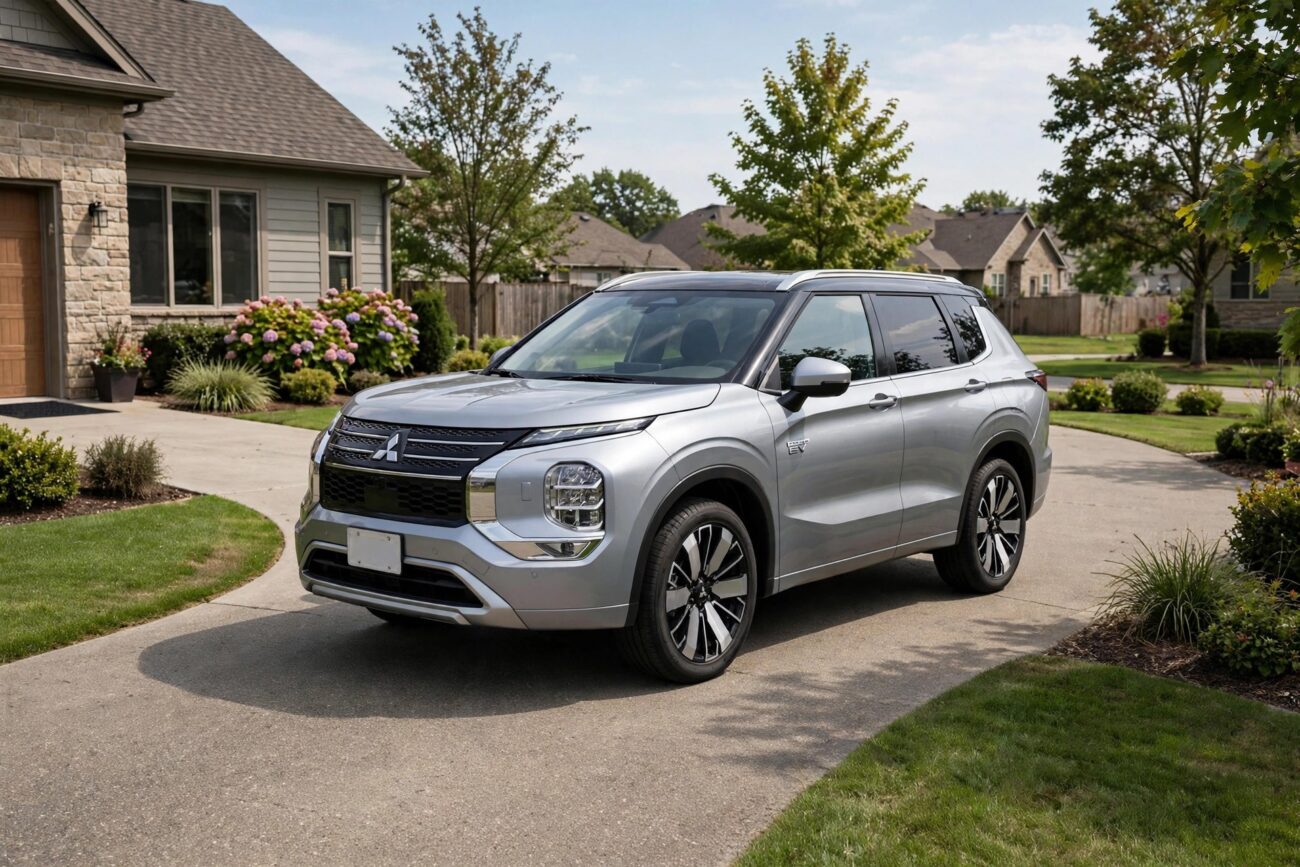
The 2026 Mitsubishi Outlander PHEV has been refreshed in the ways that matter most to plug in hybrid buyers: a bigger battery, more electric range, more power, and a higher price. It is still the only plug in hybrid in its class with three rows of seats, and that alone makes it worth a close look for families who want electric commuting without giving up space. This Mitsubishi Outlander PHEV buyers guide explains the 2026 changes, the trim prices, the real range and charging times, and how it compares with its closest rivals, so you can decide whether it fits your life.
We use the 2026 refresh figures from Edmunds as the anchor throughout this guide, because some sources still show the older pre refresh numbers in their spec tables. Where sources disagree, we say so, so you are not caught out by a number that belongs to last year model.
What Is the Mitsubishi Outlander PHEV?
The Outlander PHEV is a plug in hybrid SUV. It pairs a 2.4 litre four cylinder petrol engine with two electric motors and a battery you can charge at home or at a public charger. For short trips, it can drive on electric power alone, using no petrol at all. For longer trips, the petrol engine takes over or works with the motors, giving you the total range of a normal SUV with no need to plan charging stops.
It is built on the regular Outlander, a three row family SUV, and it keeps the same practical shape: a roomy second row, a small third row for children or short trips, and a large boot with the third row folded. Standard all wheel drive, a 10 year or 100,000 mile powertrain warranty, and a full set of driver assistance features come with every trim. For buyers who want electric driving for the daily commute and petrol range for weekends, it is a practical middle ground between a normal SUV and a full electric car.
What Is New for 2026?
The 2026 refresh is a real update, not a light facelift. The battery grows from 20 kWh to 22.7 kWh, and total system output rises from 248 hp to 297 hp. Electric only range rises from 38 miles to 45 miles on the EPA cycle, and the 0 to 60 mph time improves to about 7.3 seconds. Fuel economy is rated at about 73 MPGe, with a total range of about 420 miles from its 14 gallon tank.
Inside, the 2026 model gets a 12.3 inch touchscreen and a Yamaha audio system as standard, along with updated driver assistance features. A new Black Edition trim joins the range for 2026, adding black exterior details and a sportier look. The styling is sharper too, with a revised front end and new wheel designs, but the biggest changes are the ones you feel every day: more power when you need it, and more electric miles before the engine starts.
Be careful when reading spec tables online. Kelley Blue Book news coverage confirms the 2026 refresh, but its spec table still shows the pre refresh 248 hp and 38 mile figures in places. Use the 2026 refresh figures in this guide, and confirm the final numbers on the window sticker of the car you are buying.
Trims and Prices
The 2026 Outlander PHEV comes in four trims: ES, SE, SEL, and the new Black Edition. Edmunds lists the 2026 price range at $43,245 to $53,695, while Kelley Blue Book lists a starting price of $45,435 in its overview, or $44,990 including destination in its news coverage. Prices vary by dealer and by options, so treat these as a starting guide and confirm the out the door price before you buy.
| Trim | Typical price | What you get |
|---|---|---|
| ES | From about $43,245 to $44,990 | Base trim, 12.3 inch screen, standard safety kit, cloth seats |
| SE | Under $50,000 | Best value trim, extra comfort and tech, Edmunds pick |
| SEL | About $50,000 to $52,000 | Leather, premium audio, more driver assistance |
| Black Edition | About $53,695 | Top trim, black exterior details, full feature set |
Edmunds recommends the SE as the sweet spot, because it adds the comfort and tech features most buyers want while staying under $50,000. The ES is the value choice if you want the plug in hybrid system at the lowest price. The SEL and Black Edition add leather, a better sound system, and more assistance features, but they push the price past $50,000, where the value case gets weaker.
Check for incentives before you buy. Federal and state incentives for plug in hybrids change often, and dealer discounts vary by region and by stock. A $2,000 discount or a low finance rate can matter more than the difference between two trims, so get quotes from two or three dealers and compare the total cost, not just the sticker price.
Range, Charging, and Running Costs
Electric only range is 45 miles on the EPA cycle, up from 38 miles before the refresh. That covers most daily commutes and school runs on electric power alone, if you charge at home overnight. Total range is about 420 miles with a full battery and a full 14 gallon tank, so long trips need no planning at all.
Charging times depend on how you charge. A normal home socket, known as Level 1, takes about 16.5 hours for a full charge, which is slow but workable if you plug in every night. A 240 volt home charger, known as Level 2, takes about 6.5 hours, which is the practical choice for most owners. A DC fast charger can take the battery to about 80 percent in about 29 minutes, using the CHAdeMO connector, though fast charging is best kept for occasional use rather than daily charging.
Running costs are where the Outlander PHEV makes its case. If your daily drive is under 45 miles and you charge at home on a normal electricity rate, most of your miles cost far less than petrol miles. On longer trips, the petrol engine delivers about 73 MPGe combined in hybrid mode. Your real savings depend on your electricity price, your petrol price, and how often you charge, but a driver who charges nightly and rarely exceeds the electric range will see the biggest benefit.
Space, Comfort, and Tech
The Outlander PHEV seats seven, which is unusual for a plug in hybrid. The third row is small and best for children or short trips, but it is there when you need it, and rivals such as the RAV4 Plug in and Tucson PHEV do not offer it at all. With the third row folded, boot space is generous for a family SUV, and the flat floor makes loading easy.
The cabin is quiet and comfortable, with good seats in the first two rows and a simple, clear layout. The 12.3 inch touchscreen is standard, with Apple CarPlay and Android Auto, and the Yamaha audio system is a pleasant surprise at this price. Driver assistance features include adaptive cruise control, lane keeping assistance, blind spot warning, and automatic emergency braking, with more features on higher trims.
Towing capacity is modest for the class, so check the rating if you plan to tow a trailer or a small boat. The battery sits under the floor, so cabin and boot space are barely affected, which is a common worry with plug in hybrids that does not apply here.
How It Compares With Rivals
The closest rivals are the Toyota RAV4 Plug in, the Hyundai Tucson PHEV, and the Honda CR-V Hybrid. Each has a different strength, and the right choice depends on what you value most.
- Toyota RAV4 Plug in: about 302 hp, from about $46,210, with a strong reputation for reliability. It has slightly more power than the Outlander PHEV, but no third row and less electric range in some trims.
- Hyundai Tucson PHEV: about 32 miles of electric range, with a lower price and a long warranty of its own. It is a good value choice, but its electric range is well short of the Outlander 45 miles.
- Honda CR-V Hybrid: a normal hybrid, not a plug in, so it cannot drive on electric power alone for a daily commute. It is simpler to own, but it cannot match the Outlander fuel savings for a driver who charges nightly.
The Outlander PHEV wins on three things: electric range, seven seats, and warranty. The RAV4 wins on power and resale value. The Tucson wins on price. If you need seven seats and you charge at home, the Outlander is the clear pick. If you never charge and you want the strongest resale, the RAV4 deserves a look.
Who Should Buy It?
The Outlander PHEV suits a driver with a daily commute under 45 miles, a place to charge at home, and a need for seven seats or a large family SUV. It also suits buyers who want electric driving without range anxiety, because the petrol engine removes the need to plan charging stops on long trips.
It is a weaker choice if you cannot charge at home, because then you are carrying a heavy battery you rarely use, and a normal hybrid may serve you better. It is also a weaker choice if you need strong towing or if you want the fastest SUV in the class, since the RAV4 Plug in is quicker. Buyers who keep cars for a long time will value the 10 year or 100,000 mile powertrain warranty, which is one of the longest in the industry.
FAQs
How much does the 2026 Outlander PHEV cost?
The 2026 range runs from about $43,245 to $53,695 according to Edmunds, with the ES starting from about $44,990 including destination. The SE, recommended as the best value trim, sits under $50,000.
How far can it go on electric only?
Electric only range is 45 miles on the EPA cycle for the 2026 model, up from 38 miles before the refresh. Most daily commutes and school runs fit inside that range if you charge overnight.
How long does it take to charge?
A Level 2 home charger at 240 volts takes about 6.5 hours for a full charge. A normal home socket takes about 16.5 hours, and a DC fast charger can reach about 80 percent in about 29 minutes.
Which trim should I buy?
The SE is the best value, according to Edmunds, because it adds the comfort and tech features most buyers want while staying under $50,000. Choose the ES for the lowest price, or the SEL or Black Edition if you want leather and the full feature set.
Is it a 7-seater?
Yes. It seats seven, with a small third row best for children or short trips. It is the only plug in hybrid in its class with three rows, which is a key reason to choose it over the RAV4 Plug in or Tucson PHEV.
How does it compare to the RAV4 Plug-in?
The Outlander PHEV has more electric range at 45 miles and seven seats, while the RAV4 Plug in has slightly more power at about 302 hp and a stronger resale record. Choose the Outlander for space and electric range, or the RAV4 for power and resale.
Conclusion
The 2026 Mitsubishi Outlander PHEV is a stronger car than the model it replaces, with more power, more electric range, and a better cabin, at a price that still undercuts many rivals. Its 45 mile electric range covers most daily driving, its seven seats are unique in the class, and its 10 year warranty is hard to beat. If you can charge at home and you need a family SUV, put the SE trim at the top of your test drive list, and compare it with the RAV4 Plug in before you decide.
Related Reading: What Is Comprehensive Car Insurance Coverage Explained, How to Lower Car Insurance Premiums: Tips
