
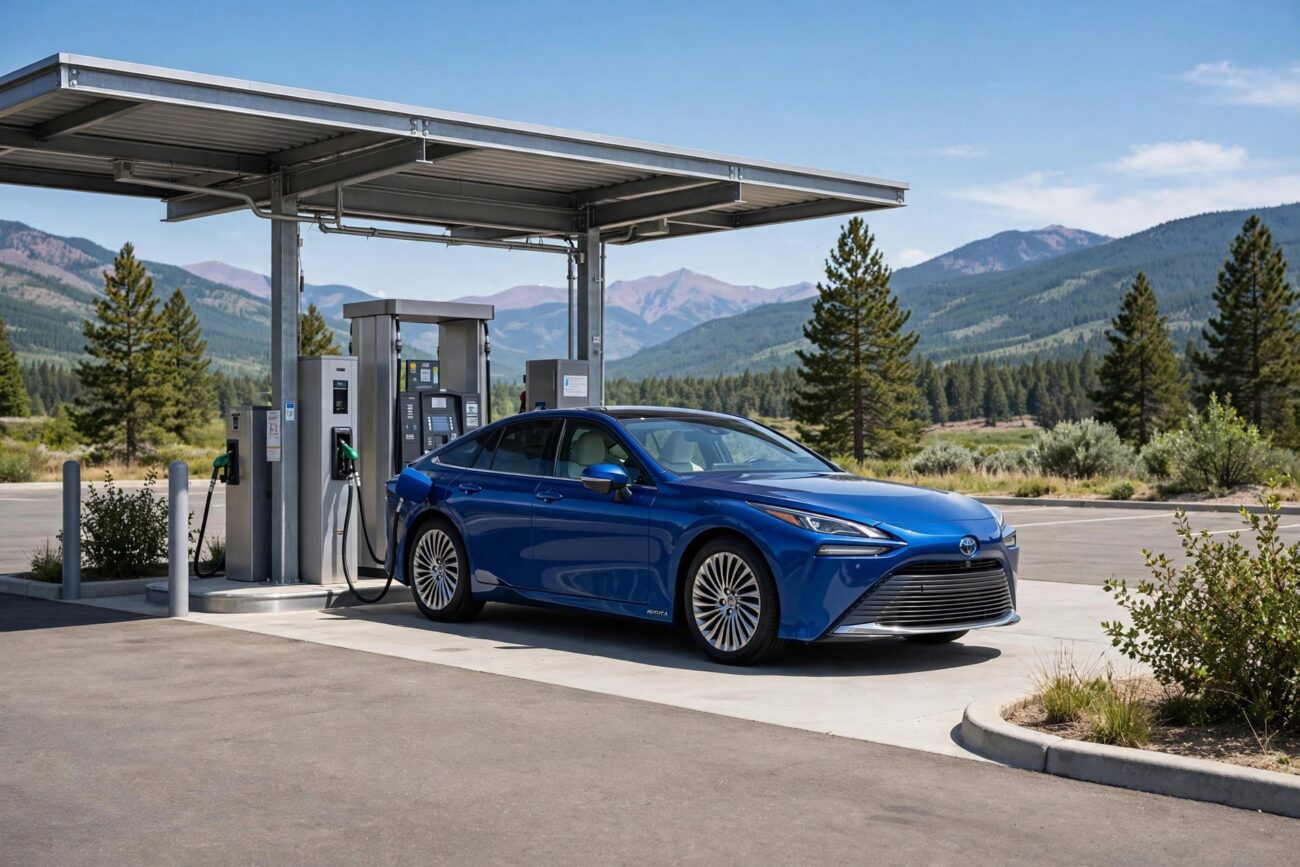
The Toyota Mirai is one of the most unusual cars you can buy. It runs on hydrogen, it emits only water vapour, it refuels in about five minutes, and it can travel 402 miles on a full tank. It also has one serious catch: almost every hydrogen station in the United States is in California. This Toyota Mirai guide explains the range, the fueling, and the real running costs, so you can decide whether this car makes sense for you, or whether a battery electric car is the better choice.
Hydrogen prices vary widely by station, so this guide gives ranges rather than a single exact price, and it explains the $15,000 fuel credit as a timeline, not just a headline number. All figures are for the 2026 model unless stated otherwise, and you should confirm current prices and station availability before you buy.
What Is the Toyota Mirai?
The Mirai is a hydrogen fuel cell electric car. Instead of a large battery, it carries hydrogen in a tank at very high pressure, about 700 bar or 10,000 psi. A fuel cell turns that hydrogen and oxygen from the air into electricity, which powers a single electric motor at the rear. The only thing that comes out of the tailpipe is water vapour.
The result is a car that drives like an electric car, quiet, smooth, and instant in its response, but refuels like a petrol car, in about five minutes at a hydrogen station. The 2026 Mirai starts at $53,090, and it comes as a large, comfortable sedan with a premium cabin, a long list of standard features, and a calm, refined ride.
It is a niche car by design. Toyota sells it mainly in California, where the hydrogen stations are, and it is aimed at buyers who want a zero emission car without the charging time of a battery electric car, and who live near a reliable hydrogen station.
Range and Performance
EPA rated range is 402 miles on a full tank of about 5.6 kg of hydrogen. Real world range is typically 370 to 450 miles, depending on your driving style, the weather, and how much motorway driving you do. That is more range than most battery electric cars at this price, and it comes with no need to plan charging stops on a long trip, as long as there is a hydrogen station on your route.
Performance is modest rather than sporty. A single rear motor makes 182 hp, and 0 to 60 mph takes about 9.1 seconds. That is enough for relaxed daily driving and motorway cruising, but it is not quick by electric car standards. Fuel economy is rated at 76 MPGe in the city and 71 MPGe on the motorway, which is efficient, though the cost per mile depends on the price of hydrogen where you fill up.
The cabin is quiet and comfortable, with good seats and a premium feel, but the boot is small at only about 10 cubic feet, because the hydrogen tanks take up space under the rear of the car. If you regularly carry large luggage, check the boot in person before you buy.
How Hydrogen Fueling Works
Fueling a Mirai is simple and fast. You drive to a hydrogen station, connect the nozzle, and the tank fills in about five minutes, much like filling a petrol car. There is no waiting for a battery to charge, and no need to plan an overnight charge. For drivers who hate waiting at chargers, this is the Mirai strongest selling point.
The problem is where the stations are. There are about 60 hydrogen stations in the United States, and almost all of them are in California, clustered around Los Angeles, San Francisco, and San Diego. Outside California, you will struggle to find a station at all. Even inside California, stations can be closed for maintenance, or out of hydrogen, so owners learn to check station status on an app before they drive there.
Before you buy, map the stations near your home, your work, and your regular routes. If there is no reliable station within easy reach, the Mirai will be a source of stress, not convenience. A battery electric car with home charging is a better choice for most buyers outside California.
How Much Does It Cost to Fuel?
Hydrogen is expensive, and its price varies widely by station. In California, hydrogen typically costs $12 to $18 per kg, though some stations charge as much as $25.99 per kg, and older quotes have reached $36 per kg. A full tank of about 5.6 kg therefore costs roughly $73 to $146 at current California prices, depending on the station you use.
That works out to about $0.10 to $0.36 per mile, which is higher than the cost per mile of a battery electric car charged at home, and often higher than a petrol car too. The exact figure depends on where you fill up, so treat any single price you see online as a snapshot, not a promise. Always check the current price at your local stations before you buy.
| Hydrogen price | Full tank, about 5.6 kg | Cost per mile, 402 miles |
|---|---|---|
| $12 per kg | About $67 | About $0.17 |
| $15 per kg | About $84 | About $0.21 |
| $18 per kg | About $101 | About $0.25 |
| $26 per kg | About $146 | About $0.36 |
The table uses the EPA range of 402 miles. Your real cost per mile will be higher if your real range is lower, and lower if you find a cheaper station. The key point is that hydrogen fuel is not cheap, and the Mirai running costs are higher than most buyers expect when they first hear about the car.
The $15,000 Fuel Credit, Explained
Toyota offers up to $15,000 of complimentary hydrogen with a new Mirai, and this is the number that makes the running costs work for many owners. The credit is not cash, and it is not unlimited. It is a fuel card or account credit that you use at hydrogen stations, and it comes with a time limit.
For a purchase, the credit typically lasts up to six years. For a lease, it typically lasts up to three years. The exact terms change with each offer, and the brochure offer cited in many guides applied to purchases by 31 March 2026, so confirm the current terms with a dealer before you rely on it. Once the credit runs out, you pay the full hydrogen price yourself, which is why the credit matters so much to the ownership maths.
Work it through as a timeline. If you drive 12,000 miles a year and your fuel costs about $0.21 per mile, you will spend about $2,500 a year on hydrogen. A $15,000 credit covers about six years of fuel at that rate, which matches the purchase term. If hydrogen prices rise, or you drive more, the credit runs out sooner. If you drive less, it lasts longer. Either way, the credit is a bridge, not a permanent discount.
Ownership Costs and Warranty
Beyond fuel, the Mirai is a Toyota, and its running costs are mostly familiar. Servicing is similar to other Toyota sedans, and Toyota includes three years or 35,000 miles of complimentary maintenance. The warranty covers three years or 36,000 miles for the limited warranty, and five years or 60,000 miles for the powertrain.
The weak point is resale value. Hydrogen cars are a niche market, and used Mirai prices have fallen sharply. One source cites a drop of about 40 percent in two years, though that figure comes from a single source and depends on the car, the mileage, and the market at the time. Do not treat it as a fact for every car, but do treat it as a warning: a Mirai is a car to buy because you want it and you can use it, not because you expect it to hold its value.
Insurance costs are similar to other large sedans at this price, but get a quote before you buy, since rates vary by insurer and by location. Also check whether your insurer has experience with hydrogen cars, since some smaller insurers may price them cautiously.
Mirai vs a Battery Electric Car
The choice between a Mirai and a battery electric car comes down to two questions: where do you live, and how do you refuel? If you live in California near reliable hydrogen stations, and you value five minute fueling and 402 miles of range, the Mirai has a real advantage. If you live anywhere else, or you can charge at home, a battery electric car is almost always the better choice.
- Fueling time: Mirai wins, about five minutes, versus 30 minutes or more for a fast charging electric car.
- Range: Mirai wins on paper, 402 miles, though many electric cars now offer 300 miles or more.
- Fuel cost: Battery electric wins by a wide margin, especially with home charging, where electricity costs far less per mile than hydrogen.
- Station availability: Battery electric wins by a wide margin, with thousands of chargers nationwide, versus about 60 hydrogen stations, almost all in California.
- Resale value: Battery electric wins, with a much larger used market and steadier prices.
For most buyers, the Mirai is a second car for a California household that already has a petrol or electric car for long trips outside the state. As an only car, it only works if your life fits inside the hydrogen station map.
FAQs
How far does a Toyota Mirai go on a full tank?
EPA rated range is 402 miles, and real world range is typically 370 to 450 miles, depending on driving style and weather. The tank holds about 5.6 kg of hydrogen at 700 bar.
How much does it cost to fill up?
At current California prices of $12 to $18 per kg, a full tank costs roughly $73 to $101, and at expensive stations it can reach about $146. The price varies widely by station, so check your local stations before you buy.
How long does fueling take?
About five minutes, similar to filling a petrol car. This is the Mirai biggest advantage over a battery electric car, which needs 30 minutes or more at a fast charger.
Where can I refuel it?
Almost only in California, where about 60 hydrogen stations operate. Outside California, hydrogen stations are rare, so check the station map for your area before you buy, and check station status before each trip.
Is the Mirai worth it?
It is worth it if you live near reliable hydrogen stations in California, you value fast fueling and long range, and the $15,000 fuel credit covers your early fuel costs. Outside California, or without home access to a station, a battery electric car is usually the better choice.
How does it compare to a battery EV?
The Mirai fuels faster and goes further on a full tank, but hydrogen costs more per mile, stations are far rarer, and resale value is weaker. A battery EV wins on running costs, charging availability, and resale, while the Mirai wins on fueling time and range.
Conclusion
The Toyota Mirai is a clever car with a simple problem: the fuel is expensive and the stations are scarce. If you live in California near reliable hydrogen stations, the 402 mile range, five minute fueling, and $15,000 fuel credit make it a genuinely enjoyable car to own. If you live anywhere else, the maths does not work, and a battery electric car will serve you better. Check the station map, check the current hydrogen price, and confirm the fuel credit terms before you decide.
Related Reading: What Is Comprehensive Car Insurance Coverage Explained, How to Lower Car Insurance Premiums: Tips
